Another roundup: global SME data sources (with a focus on Asia).
General SME statistics
Google: "Google Directory- Sciences > Social Sciences > Economics > Indicators and Statistics > Official statistics > Asia." (Links to national statistical databases.)
Inforum: "Econdata."
ILO: “Key Indicators of the Labour Market (KILM) Programme.”
Inomics: "EconDirectory."
OECD: "SMEs and entrepreneurship."
Surveys
World Bank. "Doing business: benchmarking business regulations."
World Bank. "Enterprise surveys: what businesses say." (Contains some data sorted by firm size.)
World Bank. (2000). "World Business Environment Survey (WBES) 2000."
World Bank and European Bank for Reconstruction and Development. "The Business Environment and Enterprise Performance Survey (BEEPS)."
SMEs in Asia and in developing countries
APEC. "Small and medium enterprises working group."
ASEAN. "Economic integration: SMEs (links)."
DDCN. "Davidson Datacenter Network." (Focus on CIS)
UNIDO (2001). Development of clusters and networks of SMEs: The UNIDO programme. Vienna, United Nations Industrial Development Organization.
Ceglie, G. and M. Dini (1999). SME cluster and network development in developing countries: The experience of UNIDO. PSD Technical Working Paper, United Nations Industrial Development Organization.
Other useful links
AdmiNet. “Small and medium enterprises.”
UNCTAD. "StDev at UNCTAD (United Nations Conference on Trade and Development - Science & Technology for Development Network)."
World Bank. “Data and Research.”
World Bank. "World Development Indicators." (Contains some data sorted by firm size.)
Saturday


Monday
Global R&D data
Here's a roundup of useful sources for data on global research and development (with a focus on corporate R&D). Some sources were featured in earlier posts.
General indicators
UNESCO statistics cover national data on number of researchers, technicians etc., proportion of women researchers, gross R&D expenditure, education level - among others.
World Development Indicators from the World Bank include some similar numbers as well as royalties and license fees, value added, ICT expenditures, highly skilled IT workers, scientific journal articles.
The World Bank's Knowledge Assessment Methodology compiles and compares various variables that are relevant to the knowledge economy. Composite, normalized indicators can be viewed as rankings, scorecards and maps. But you can also create your own graphs and tables. Most relevant R&D indicators are included.
The World Intellectual Property Organization provides WIPO Industrial Property Statistics collected from member countries on patents, trademarks, utility models, designs, plant varieties and microorganisms.
OECD science, technology and patent data. (Some datasets include major non-member countries, such as India, China and Brazil.)
For the US: NSF statistics on the science and engineering workforce available at SESTAT
On the globalization of corporate R&D and the impact of multinationals, especially in developing countries
UNCTAD has 3 particularly useful publications (all from 2005).
- WIR 2005. World Investment Report 2005: TNCs and the internationalization of R&D
- UNCTAD survey on the internationalization of R&D: Current patterns and prospects on the internationalization of R&D
- Globalization of R&D and developing countries. Expert Meeting, Geneva, January 2005
Also from UNCTAD: The UNCTAD Innovation Capability Index, first published in WIR 2005.
The internationalization of corporate R&D: Leveraging the changing geography of innovation. ITPS 2006. This includes country-specific case studies, incl. China and India.
5 surveys of corporate global R&D:
- Harnessing innovation: R&D in a global growth economy (Economist Intelligence Unit, May 2004)
- Scattering the seeds of invention: The globalisation of research and development (Economist Intelligence Unit, September 2004)
- Innovation: Is global the way forward? (INSEAD and Booz Allen Hamilton, 2006. Survey conducted May 2005)
- Innovation 2006. Annual innovation survey by The Boston Consulting Group
- R&D 100, 2005. IEEE Spectrum's Annual Survey of the top 100 R&D spenders
General indicators
UNESCO statistics cover national data on number of researchers, technicians etc., proportion of women researchers, gross R&D expenditure, education level - among others.
World Development Indicators from the World Bank include some similar numbers as well as royalties and license fees, value added, ICT expenditures, highly skilled IT workers, scientific journal articles.
The World Bank's Knowledge Assessment Methodology compiles and compares various variables that are relevant to the knowledge economy. Composite, normalized indicators can be viewed as rankings, scorecards and maps. But you can also create your own graphs and tables. Most relevant R&D indicators are included.
The World Intellectual Property Organization provides WIPO Industrial Property Statistics collected from member countries on patents, trademarks, utility models, designs, plant varieties and microorganisms.
OECD science, technology and patent data. (Some datasets include major non-member countries, such as India, China and Brazil.)
For the US: NSF statistics on the science and engineering workforce available at SESTAT
On the globalization of corporate R&D and the impact of multinationals, especially in developing countries
UNCTAD has 3 particularly useful publications (all from 2005).
- WIR 2005. World Investment Report 2005: TNCs and the internationalization of R&D
- UNCTAD survey on the internationalization of R&D: Current patterns and prospects on the internationalization of R&D
- Globalization of R&D and developing countries. Expert Meeting, Geneva, January 2005
Also from UNCTAD: The UNCTAD Innovation Capability Index, first published in WIR 2005.
The internationalization of corporate R&D: Leveraging the changing geography of innovation. ITPS 2006. This includes country-specific case studies, incl. China and India.
5 surveys of corporate global R&D:
- Harnessing innovation: R&D in a global growth economy (Economist Intelligence Unit, May 2004)
- Scattering the seeds of invention: The globalisation of research and development (Economist Intelligence Unit, September 2004)
- Innovation: Is global the way forward? (INSEAD and Booz Allen Hamilton, 2006. Survey conducted May 2005)
- Innovation 2006. Annual innovation survey by The Boston Consulting Group
- R&D 100, 2005. IEEE Spectrum's Annual Survey of the top 100 R&D spenders
Thursday
Taiwan-India, China-India linkages
Anyone following AnnaLee Saxenian's work is aware of the close connections between the semiconductor industries in Silicon Valley, Taiwan, and - more recently - Shanghai. I have been wondering for a while whether India had the potential to become the next node in this evolving network.
While the semiconductor industry is still quite small in India, there have been some interesting developments. Silicon Valley firms already do some of their chip design work to Bangalore, Hyderabad etc. Plans for Fab City in Hyderabad appear to be firming up after much bickering and speculation. Now, a panel discussion between the Taiwan Semiconductor Industry Association (TSIA) and its Indian counterpart, ISA, is being heralded. It's a small step: TSIA's discussions revolved around partnering with India for chip design and embedded software.
During a panel discussion in STMicroelectronics campus in Greater Noida, between TSIA and the India Semiconductor Association (ISA) on "Opportunities and areas of cooperation between India and Taiwan," TSIA was quite clear that in the absence of an ecosystem and industry infrastructure for setting up manufacturing units, including fabs in India, Taiwanese firms would be ready to tap the IC design and embedded software development skills of Indian engineers for innovating and developing new technologies and products.
"Taiwan is an established manufacturing hub in the semiconductor industry, and we see a great potential to outsource a host of requirements ranging from chip design, testing, packaging and embedded software to developing IPs from our Indian counterparts," said, Paul Chiang, VP, Nanya Technology.
James P. M. Chen, VP, Sales center, Winbond Electronics, a leading Taiwanese semiconductor said his company would be willing to invest in India or collaborate with Indian firms to build a R&D facility as there is no dearth of quality designers in India.
"Voice&Data" seem to have a particular interest in tracking the India-China story...
While the semiconductor industry is still quite small in India, there have been some interesting developments. Silicon Valley firms already do some of their chip design work to Bangalore, Hyderabad etc. Plans for Fab City in Hyderabad appear to be firming up after much bickering and speculation. Now, a panel discussion between the Taiwan Semiconductor Industry Association (TSIA) and its Indian counterpart, ISA, is being heralded. It's a small step: TSIA's discussions revolved around partnering with India for chip design and embedded software.
During a panel discussion in STMicroelectronics campus in Greater Noida, between TSIA and the India Semiconductor Association (ISA) on "Opportunities and areas of cooperation between India and Taiwan," TSIA was quite clear that in the absence of an ecosystem and industry infrastructure for setting up manufacturing units, including fabs in India, Taiwanese firms would be ready to tap the IC design and embedded software development skills of Indian engineers for innovating and developing new technologies and products.
"Taiwan is an established manufacturing hub in the semiconductor industry, and we see a great potential to outsource a host of requirements ranging from chip design, testing, packaging and embedded software to developing IPs from our Indian counterparts," said, Paul Chiang, VP, Nanya Technology.
James P. M. Chen, VP, Sales center, Winbond Electronics, a leading Taiwanese semiconductor said his company would be willing to invest in India or collaborate with Indian firms to build a R&D facility as there is no dearth of quality designers in India.
"Voice&Data" seem to have a particular interest in tracking the India-China story...
Saturday
BCG on R&D in India and China
Boston Consulting Group, Innovation 2006
Over the past year and a half, BCG has published various surveys, reports and “opportunities for action” on research and development in India, China and other rapidly emerging economies. The most interesting data are in the Innovation Survey 2006.
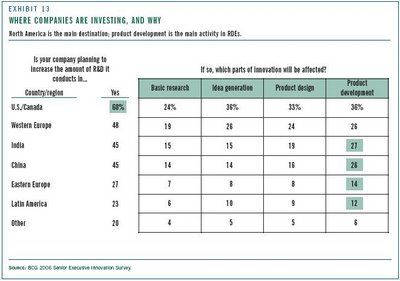
The largest target market for increased R&D spending remains the USA. And Western Europe still comes in second, albeit barely. India and China are rapidly becoming more important. About 45% of respondents said their company planned to increase R&D spending in China; and the same number planned to increase R&D spending in India. This is up from 2005, when only one-third of companies were planning to increase their R&D investments in 'rapidly developing economies.'
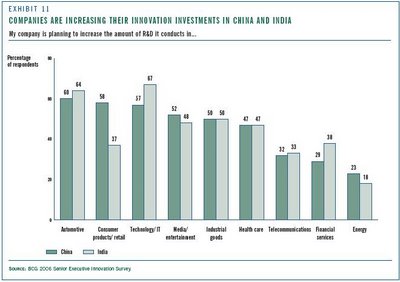
China draws increased R&D investments from significantly more consumer product/retail companies than India does. However in every other industry in the survey more or the same number of companies planned to increase their Indian R&D spending (see graph below). This comes as something as a surprise since it suggests stronger R&D growth for India than China. It is important to remember, though that China receives more foreign R&D investments in absolute terms - both FDI dollars and number of labs - and remains the most attractive location for future investments. (See UNCTAD's World Investment Report 2005 ch. 3-4.)
According to BCG's survey, cost – 34% of respondents – and localization (access to local markets) – 32% of respondents – are the main drivers for these investments. Access to R&D talent was mentioned by 21% of respondents.
The Economist Intelligence Unit (EIU) found similar drivers in their 2004 study but weighted them differently: Competition for talent, new technologies and easier market access have accelerated the process of R&D globalisation, with countries such as India and China hosting significant volumes of R&D activity for multinationals. Cost is a driver of globalisation too, but its significance can be overplayed as far as R&D goes. ... Speed of development is a more important benefit of the global research economy.
BCG also investigated the type of R&D being conducted in India and China. For anyone who's been watching the R&D space in Bangalore, Beijing and Shanghai it should come as no surprise that most of the investments are D rather than R. The main activity in India and China is product development, followed by product design. However, 15% of respondents said that their increased R&D spending would affect basic research and idea generation.
 Conclusions
BCG encourages readers to reconsider the strategies in rapidly developing economies (RDEs), especially in terms of utilizing local talent to conduct more basic research and idea generation in these locations. This is somewhat at odds with the laments of companies that do engage in very high-end research: Development talent is plentiful, but research talent is very hard to find in most industries.
A note on the survey sample: Of the 1'070 respondents to the survey 450 were employed in the US, 71 in India, and 15 in China. The bulk of the rest were from Western economies. I wonder whether this skewed some of the comparative figures on India and China...
Over the past year and a half, BCG has published various surveys, reports and “opportunities for action” on research and development in India, China and other rapidly emerging economies. The most interesting data are in the Innovation Survey 2006.
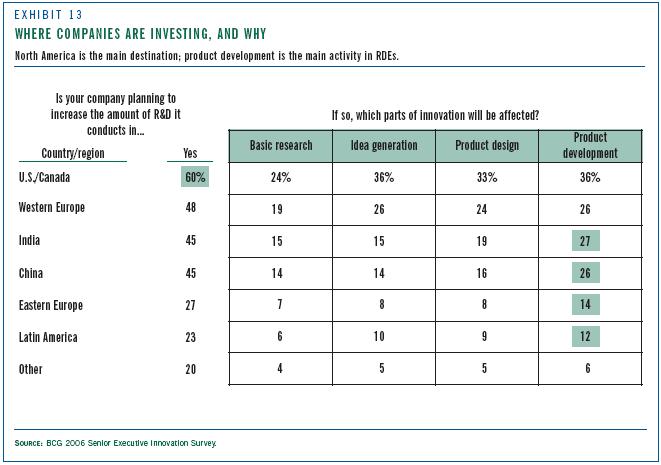
The largest target market for increased R&D spending remains the USA. And Western Europe still comes in second, albeit barely. India and China are rapidly becoming more important. About 45% of respondents said their company planned to increase R&D spending in China; and the same number planned to increase R&D spending in India. This is up from 2005, when only one-third of companies were planning to increase their R&D investments in 'rapidly developing economies.'
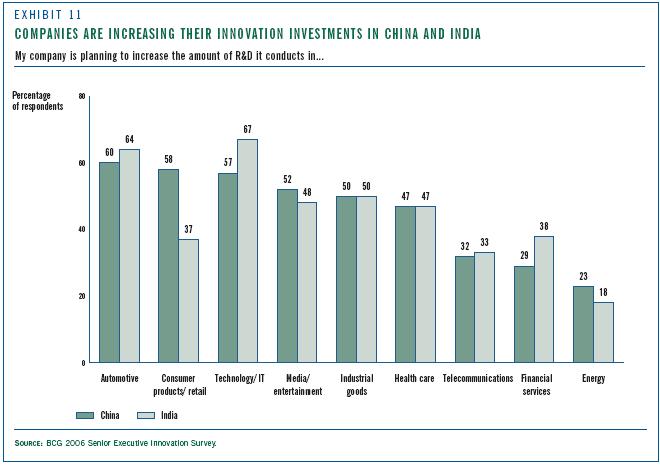
China draws increased R&D investments from significantly more consumer product/retail companies than India does. However in every other industry in the survey more or the same number of companies planned to increase their Indian R&D spending (see graph below). This comes as something as a surprise since it suggests stronger R&D growth for India than China. It is important to remember, though that China receives more foreign R&D investments in absolute terms - both FDI dollars and number of labs - and remains the most attractive location for future investments. (See UNCTAD's World Investment Report 2005 ch. 3-4.)
According to BCG's survey, cost – 34% of respondents – and localization (access to local markets) – 32% of respondents – are the main drivers for these investments. Access to R&D talent was mentioned by 21% of respondents.
The Economist Intelligence Unit (EIU) found similar drivers in their 2004 study but weighted them differently: Competition for talent, new technologies and easier market access have accelerated the process of R&D globalisation, with countries such as India and China hosting significant volumes of R&D activity for multinationals. Cost is a driver of globalisation too, but its significance can be overplayed as far as R&D goes. ... Speed of development is a more important benefit of the global research economy.
BCG also investigated the type of R&D being conducted in India and China. For anyone who's been watching the R&D space in Bangalore, Beijing and Shanghai it should come as no surprise that most of the investments are D rather than R. The main activity in India and China is product development, followed by product design. However, 15% of respondents said that their increased R&D spending would affect basic research and idea generation.
 Conclusions
BCG encourages readers to reconsider the strategies in rapidly developing economies (RDEs), especially in terms of utilizing local talent to conduct more basic research and idea generation in these locations. This is somewhat at odds with the laments of companies that do engage in very high-end research: Development talent is plentiful, but research talent is very hard to find in most industries.
A note on the survey sample: Of the 1'070 respondents to the survey 450 were employed in the US, 71 in India, and 15 in China. The bulk of the rest were from Western economies. I wonder whether this skewed some of the comparative figures on India and China...
Subscribe to:
Posts (Atom)
