"How green are China's cities?" McKinsey Quarterly, January 2011.
In connection with the World Economic Forum's themes, McKinsey has published the results of a new study on the sustainability of China's cities. Unsurprisingly, they found huge differences between individual cities.
What may come as a surprise though, is that there was no causal link between sustainability and economic growth. Almost a third of the cities studied were "sustainable growers." They expanded economically while improving on sustainability measures. McKinsey found many "all-round" high performers, suggesting that good city management is key to success, and may even be more influential than potential trade-offs between growth and greening.
Showing posts with label China. Show all posts
Showing posts with label China. Show all posts


Monday
Survey on Indian and Chinese immigrants/returnees
Wadhwa, V., Saxenian, A., Freeman, R. B., & Gereffi, G. (2009). America's Loss is the World's Gain: America's New Immigrant Entrepreneurs, Part 4. Available at SSRN: http://ssrn.com/abstract=1348616.
This just landed in my inbox... I've been wondering for a long time where to find numbers on Indians returning to India from the US. There is still no comprehensive data, but Wadhwa et al. have been interviewing Indian and Chinese students and alumni of US universities for several years and put together a decent sample.
The study is skewed towards the most highly educated immigrants/returnees. These are the people most likely to contribute disproportionately to science and technology in the countries where they choose to live.
Here are some highlights:
We find that, though restrictive immigration policies caused some returnees to depart the United States, the most significant factors in the decision to return home were career opportunities, family ties, and quality of life.
Immigration to the US and back to the home country appears to be driven by very similar (though not exactly the same) reasons.
The returnees cited career, education, and quality of life as the main reasons to come to the United States.
- Amongst the strongest factors bringing these immigrants to the U.S. were professional and educational development opportunities. Of Indian and Chinese respondents, 93.5 percent and 91.6 percent respectively said that professional development was an important factor, and 85.9 percent and 90.5 percent respectively said that educational development was important in their decision to migrate to the United States.
- Other key factors were quality-of-life concerns, better infrastructure and facilities, and better compensation. The majority (67.4 percent of Indians and 69.1 percent of Chinese) said that the availability of jobs in their home countries was not a consideration in their decision to migrate to the United States.
Returnees cited career and quality of life as the main reason to return to their home country rather than stay in the United States.
- The commonest professional factor (86.8% of Chinese and 79.0 percent of Indians) motivating workers to return home was the growing demand for their skills in their home countries.
- A significant majority (84.0% of Chinese and 68.7 percent of Indians) believed that
their home countries provided better career opportunities. Furthermore, 87.3 percent of Chinese and 62.3 percent of Indians saw better career opportunities in their home countries than in the United States.
- Financial compensation was a factor important to 62.1 percent of Chinese and 49.2 percent of Indian returnees.
Family considerations are strong magnets pulling immigrants back to their home countries. Care for aging parents was considered by 89.4 percent of Indians and 79.1 percent of Chinese respondents to be much better in their home countries. Family
values were also considered to be better in their home countries by 79.7 percent of Indians and 67.0 percent of Chinese. Additionally, 88.0 percent of Indians and 76.8 percent of Chinese reported that the opportunity to be close to family and friends was better at home.
Indians, in particular, believe that their quality of life is better in India than in the US, and that India provides their children with a better environment in terms of emotional growth and education.
While visa issues were not cited as a main driver of the decision to return home, they were often mentioned as a significant difficulty of settling in the US and exacerbating the distance to family and friends by restricting travel.
Once they are back in their home country, returnees tend to do well, advancing faster in their careers than they would have in the US. They view financial compensation (adjusted for cost of living) and career appreciation as better than in the US. However, they also face significant difficulties from reverse culture shock to infrastructure problems and pollution.
26.4 percent of Chinese and 26.5 percent of Indian returnees indicated that it was highly unlikely that they would return to the US.
This just landed in my inbox... I've been wondering for a long time where to find numbers on Indians returning to India from the US. There is still no comprehensive data, but Wadhwa et al. have been interviewing Indian and Chinese students and alumni of US universities for several years and put together a decent sample.
The study is skewed towards the most highly educated immigrants/returnees. These are the people most likely to contribute disproportionately to science and technology in the countries where they choose to live.
Here are some highlights:
We find that, though restrictive immigration policies caused some returnees to depart the United States, the most significant factors in the decision to return home were career opportunities, family ties, and quality of life.
Immigration to the US and back to the home country appears to be driven by very similar (though not exactly the same) reasons.
The returnees cited career, education, and quality of life as the main reasons to come to the United States.
- Amongst the strongest factors bringing these immigrants to the U.S. were professional and educational development opportunities. Of Indian and Chinese respondents, 93.5 percent and 91.6 percent respectively said that professional development was an important factor, and 85.9 percent and 90.5 percent respectively said that educational development was important in their decision to migrate to the United States.
- Other key factors were quality-of-life concerns, better infrastructure and facilities, and better compensation. The majority (67.4 percent of Indians and 69.1 percent of Chinese) said that the availability of jobs in their home countries was not a consideration in their decision to migrate to the United States.
Returnees cited career and quality of life as the main reason to return to their home country rather than stay in the United States.
- The commonest professional factor (86.8% of Chinese and 79.0 percent of Indians) motivating workers to return home was the growing demand for their skills in their home countries.
- A significant majority (84.0% of Chinese and 68.7 percent of Indians) believed that
their home countries provided better career opportunities. Furthermore, 87.3 percent of Chinese and 62.3 percent of Indians saw better career opportunities in their home countries than in the United States.
- Financial compensation was a factor important to 62.1 percent of Chinese and 49.2 percent of Indian returnees.
Family considerations are strong magnets pulling immigrants back to their home countries. Care for aging parents was considered by 89.4 percent of Indians and 79.1 percent of Chinese respondents to be much better in their home countries. Family
values were also considered to be better in their home countries by 79.7 percent of Indians and 67.0 percent of Chinese. Additionally, 88.0 percent of Indians and 76.8 percent of Chinese reported that the opportunity to be close to family and friends was better at home.
Indians, in particular, believe that their quality of life is better in India than in the US, and that India provides their children with a better environment in terms of emotional growth and education.
While visa issues were not cited as a main driver of the decision to return home, they were often mentioned as a significant difficulty of settling in the US and exacerbating the distance to family and friends by restricting travel.
Once they are back in their home country, returnees tend to do well, advancing faster in their careers than they would have in the US. They view financial compensation (adjusted for cost of living) and career appreciation as better than in the US. However, they also face significant difficulties from reverse culture shock to infrastructure problems and pollution.
26.4 percent of Chinese and 26.5 percent of Indian returnees indicated that it was highly unlikely that they would return to the US.
Friday
Argonauts, ethnic scientific communities
AnnaLee Saxenian, The New Argonauts, Harvard University Press, 2006
William Kerr, Ethnic Scientific Communities and International Technology Diffusion, HBS Working Paper 06-022, 2006
Ajay Agrawal, Devesh Kapur, John McHale, Defying Distance: Examining the Influence of the Diaspora on Scientific Knowledge Flows, Working Paper 2004
Entrepreneurial networks carry regional advantage across distance
AnnaLee Saxenian has long been a follower of localized firm and professional networks in the hi-tech industry, highlighting their superiority over corporate hierarchies in her book "Regional Advantage." More recently, in "The New Argonauts," she has turned to ethnic professional networks in Silicon Valley, especially in the Indian, Chinese and Israeli communities. These networks, originally founded for social purposes, evolved to become professional networks for advice, capital and know-how for immigrant entrepreneurs. As immigrant entrepreneurs in Silicon Valley identified business opportunities in their home countries, the networks extended to support these new ventures. They also tied into their home-countries' networks through alumni associations and family ties.
Thus, organizations that were once highly localized began to reach across continents - and their benefits with them. Access to tacit knowledge (technical and managerial), a common understanding of entrepreneurship, shared language and culture have all been considered factors that are bound by geography and contribute to the success of regional economies. Now, they are transcending vast distances thanks to the kinds of networks described by Saxenian. New "Argonauts" (people who work in two or more regions, shuttling back and forth several times per month) literally carry market and technological knowledge, contacts, business models and capital around the world.
As a result:
Silicon Valley, once the uncontested technology leader, is now integrated into a dynamic network of specialized and complementary regional economies.
These new technology regions are not replicas of Silicon Valley, nor are they becoming new Silicon Valleys [...] Even as the returnees seek to use their experience in Silicon Valley to reshape these institutions, distinctive regional and national histories ensure that the identities and technology trajectories of these regions are unlikely to converge.
Some quantitative evidence
Ajay Agrawal, Devesh Kapur and John McHale analyzed patent citations within the Indian diaspora. They found that co-ethnicity increases the likelihood of knowledge flows. Diaspora membership is also found to substitute for co-location as a conduit for knowledge flows.
In a similar study, William Kerr has found quantitative evidence for the power of ethnic networks in a patent citation study. By linking patent data with an ethnic name-database, he was able to analyze ethnic scientific communities in the United States and the communities' home countries. He found that ethnic communities contribute significantly to technology adoption within the first five years of a new technology being developed.
Kerr also found tangible benefits for the home countries using a factor productivity approach: Greater integration with the US technology frontier contributed to an increase in manufacturing output in these countries. In more advanced economies the effect was due to productivity increases; in less advanced countries, productivity increases combined with a reallocation of labor from agriculture to manufacturing.
William Kerr, Ethnic Scientific Communities and International Technology Diffusion, HBS Working Paper 06-022, 2006
Ajay Agrawal, Devesh Kapur, John McHale, Defying Distance: Examining the Influence of the Diaspora on Scientific Knowledge Flows, Working Paper 2004
Entrepreneurial networks carry regional advantage across distance
AnnaLee Saxenian has long been a follower of localized firm and professional networks in the hi-tech industry, highlighting their superiority over corporate hierarchies in her book "Regional Advantage." More recently, in "The New Argonauts," she has turned to ethnic professional networks in Silicon Valley, especially in the Indian, Chinese and Israeli communities. These networks, originally founded for social purposes, evolved to become professional networks for advice, capital and know-how for immigrant entrepreneurs. As immigrant entrepreneurs in Silicon Valley identified business opportunities in their home countries, the networks extended to support these new ventures. They also tied into their home-countries' networks through alumni associations and family ties.
Thus, organizations that were once highly localized began to reach across continents - and their benefits with them. Access to tacit knowledge (technical and managerial), a common understanding of entrepreneurship, shared language and culture have all been considered factors that are bound by geography and contribute to the success of regional economies. Now, they are transcending vast distances thanks to the kinds of networks described by Saxenian. New "Argonauts" (people who work in two or more regions, shuttling back and forth several times per month) literally carry market and technological knowledge, contacts, business models and capital around the world.
As a result:
Silicon Valley, once the uncontested technology leader, is now integrated into a dynamic network of specialized and complementary regional economies.
These new technology regions are not replicas of Silicon Valley, nor are they becoming new Silicon Valleys [...] Even as the returnees seek to use their experience in Silicon Valley to reshape these institutions, distinctive regional and national histories ensure that the identities and technology trajectories of these regions are unlikely to converge.
Some quantitative evidence
Ajay Agrawal, Devesh Kapur and John McHale analyzed patent citations within the Indian diaspora. They found that co-ethnicity increases the likelihood of knowledge flows. Diaspora membership is also found to substitute for co-location as a conduit for knowledge flows.
In a similar study, William Kerr has found quantitative evidence for the power of ethnic networks in a patent citation study. By linking patent data with an ethnic name-database, he was able to analyze ethnic scientific communities in the United States and the communities' home countries. He found that ethnic communities contribute significantly to technology adoption within the first five years of a new technology being developed.
Kerr also found tangible benefits for the home countries using a factor productivity approach: Greater integration with the US technology frontier contributed to an increase in manufacturing output in these countries. In more advanced economies the effect was due to productivity increases; in less advanced countries, productivity increases combined with a reallocation of labor from agriculture to manufacturing.
Monday
National Innovation System timelines: India, China, USA
Found on Yoshiki Mikami's virtual class website.
This is Mikami's overview of the evolution of the Indian national innovation system from the 18th century to the present. The data on more recent decades isn't quite comprehensive, but it's useful to get a timeline.
Mikami's site also has timelines for China and the USA.
This is Mikami's overview of the evolution of the Indian national innovation system from the 18th century to the present. The data on more recent decades isn't quite comprehensive, but it's useful to get a timeline.
Mikami's site also has timelines for China and the USA.
Thursday
Taiwan-India, China-India linkages
Anyone following AnnaLee Saxenian's work is aware of the close connections between the semiconductor industries in Silicon Valley, Taiwan, and - more recently - Shanghai. I have been wondering for a while whether India had the potential to become the next node in this evolving network.
While the semiconductor industry is still quite small in India, there have been some interesting developments. Silicon Valley firms already do some of their chip design work to Bangalore, Hyderabad etc. Plans for Fab City in Hyderabad appear to be firming up after much bickering and speculation. Now, a panel discussion between the Taiwan Semiconductor Industry Association (TSIA) and its Indian counterpart, ISA, is being heralded. It's a small step: TSIA's discussions revolved around partnering with India for chip design and embedded software.
During a panel discussion in STMicroelectronics campus in Greater Noida, between TSIA and the India Semiconductor Association (ISA) on "Opportunities and areas of cooperation between India and Taiwan," TSIA was quite clear that in the absence of an ecosystem and industry infrastructure for setting up manufacturing units, including fabs in India, Taiwanese firms would be ready to tap the IC design and embedded software development skills of Indian engineers for innovating and developing new technologies and products.
"Taiwan is an established manufacturing hub in the semiconductor industry, and we see a great potential to outsource a host of requirements ranging from chip design, testing, packaging and embedded software to developing IPs from our Indian counterparts," said, Paul Chiang, VP, Nanya Technology.
James P. M. Chen, VP, Sales center, Winbond Electronics, a leading Taiwanese semiconductor said his company would be willing to invest in India or collaborate with Indian firms to build a R&D facility as there is no dearth of quality designers in India.
"Voice&Data" seem to have a particular interest in tracking the India-China story...
While the semiconductor industry is still quite small in India, there have been some interesting developments. Silicon Valley firms already do some of their chip design work to Bangalore, Hyderabad etc. Plans for Fab City in Hyderabad appear to be firming up after much bickering and speculation. Now, a panel discussion between the Taiwan Semiconductor Industry Association (TSIA) and its Indian counterpart, ISA, is being heralded. It's a small step: TSIA's discussions revolved around partnering with India for chip design and embedded software.
During a panel discussion in STMicroelectronics campus in Greater Noida, between TSIA and the India Semiconductor Association (ISA) on "Opportunities and areas of cooperation between India and Taiwan," TSIA was quite clear that in the absence of an ecosystem and industry infrastructure for setting up manufacturing units, including fabs in India, Taiwanese firms would be ready to tap the IC design and embedded software development skills of Indian engineers for innovating and developing new technologies and products.
"Taiwan is an established manufacturing hub in the semiconductor industry, and we see a great potential to outsource a host of requirements ranging from chip design, testing, packaging and embedded software to developing IPs from our Indian counterparts," said, Paul Chiang, VP, Nanya Technology.
James P. M. Chen, VP, Sales center, Winbond Electronics, a leading Taiwanese semiconductor said his company would be willing to invest in India or collaborate with Indian firms to build a R&D facility as there is no dearth of quality designers in India.
"Voice&Data" seem to have a particular interest in tracking the India-China story...
Saturday
BCG on R&D in India and China
Boston Consulting Group, Innovation 2006
Over the past year and a half, BCG has published various surveys, reports and “opportunities for action” on research and development in India, China and other rapidly emerging economies. The most interesting data are in the Innovation Survey 2006.
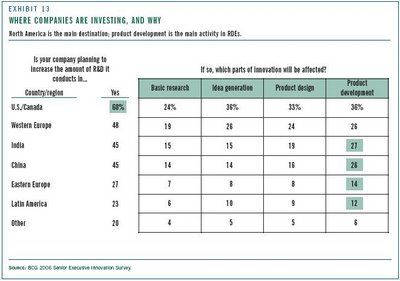
The largest target market for increased R&D spending remains the USA. And Western Europe still comes in second, albeit barely. India and China are rapidly becoming more important. About 45% of respondents said their company planned to increase R&D spending in China; and the same number planned to increase R&D spending in India. This is up from 2005, when only one-third of companies were planning to increase their R&D investments in 'rapidly developing economies.'
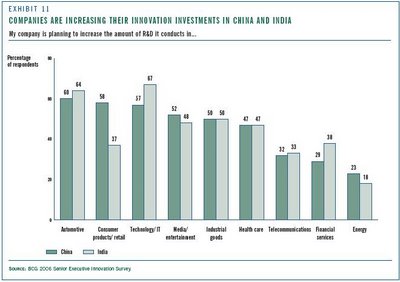
China draws increased R&D investments from significantly more consumer product/retail companies than India does. However in every other industry in the survey more or the same number of companies planned to increase their Indian R&D spending (see graph below). This comes as something as a surprise since it suggests stronger R&D growth for India than China. It is important to remember, though that China receives more foreign R&D investments in absolute terms - both FDI dollars and number of labs - and remains the most attractive location for future investments. (See UNCTAD's World Investment Report 2005 ch. 3-4.)
According to BCG's survey, cost – 34% of respondents – and localization (access to local markets) – 32% of respondents – are the main drivers for these investments. Access to R&D talent was mentioned by 21% of respondents.
The Economist Intelligence Unit (EIU) found similar drivers in their 2004 study but weighted them differently: Competition for talent, new technologies and easier market access have accelerated the process of R&D globalisation, with countries such as India and China hosting significant volumes of R&D activity for multinationals. Cost is a driver of globalisation too, but its significance can be overplayed as far as R&D goes. ... Speed of development is a more important benefit of the global research economy.
BCG also investigated the type of R&D being conducted in India and China. For anyone who's been watching the R&D space in Bangalore, Beijing and Shanghai it should come as no surprise that most of the investments are D rather than R. The main activity in India and China is product development, followed by product design. However, 15% of respondents said that their increased R&D spending would affect basic research and idea generation.
 Conclusions
BCG encourages readers to reconsider the strategies in rapidly developing economies (RDEs), especially in terms of utilizing local talent to conduct more basic research and idea generation in these locations. This is somewhat at odds with the laments of companies that do engage in very high-end research: Development talent is plentiful, but research talent is very hard to find in most industries.
A note on the survey sample: Of the 1'070 respondents to the survey 450 were employed in the US, 71 in India, and 15 in China. The bulk of the rest were from Western economies. I wonder whether this skewed some of the comparative figures on India and China...
Over the past year and a half, BCG has published various surveys, reports and “opportunities for action” on research and development in India, China and other rapidly emerging economies. The most interesting data are in the Innovation Survey 2006.
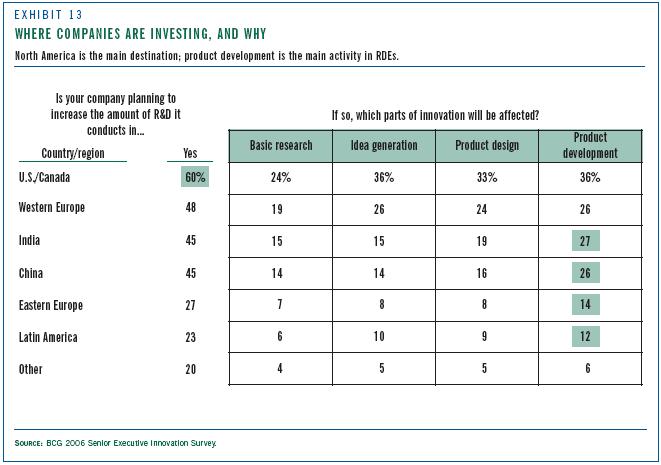
The largest target market for increased R&D spending remains the USA. And Western Europe still comes in second, albeit barely. India and China are rapidly becoming more important. About 45% of respondents said their company planned to increase R&D spending in China; and the same number planned to increase R&D spending in India. This is up from 2005, when only one-third of companies were planning to increase their R&D investments in 'rapidly developing economies.'
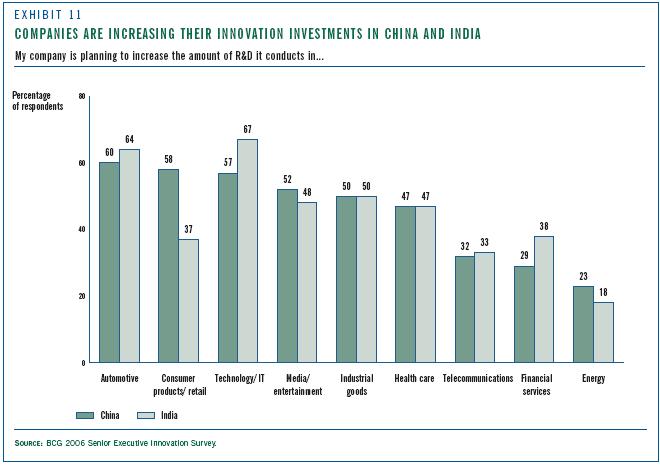
China draws increased R&D investments from significantly more consumer product/retail companies than India does. However in every other industry in the survey more or the same number of companies planned to increase their Indian R&D spending (see graph below). This comes as something as a surprise since it suggests stronger R&D growth for India than China. It is important to remember, though that China receives more foreign R&D investments in absolute terms - both FDI dollars and number of labs - and remains the most attractive location for future investments. (See UNCTAD's World Investment Report 2005 ch. 3-4.)
According to BCG's survey, cost – 34% of respondents – and localization (access to local markets) – 32% of respondents – are the main drivers for these investments. Access to R&D talent was mentioned by 21% of respondents.
The Economist Intelligence Unit (EIU) found similar drivers in their 2004 study but weighted them differently: Competition for talent, new technologies and easier market access have accelerated the process of R&D globalisation, with countries such as India and China hosting significant volumes of R&D activity for multinationals. Cost is a driver of globalisation too, but its significance can be overplayed as far as R&D goes. ... Speed of development is a more important benefit of the global research economy.
BCG also investigated the type of R&D being conducted in India and China. For anyone who's been watching the R&D space in Bangalore, Beijing and Shanghai it should come as no surprise that most of the investments are D rather than R. The main activity in India and China is product development, followed by product design. However, 15% of respondents said that their increased R&D spending would affect basic research and idea generation.
 Conclusions
BCG encourages readers to reconsider the strategies in rapidly developing economies (RDEs), especially in terms of utilizing local talent to conduct more basic research and idea generation in these locations. This is somewhat at odds with the laments of companies that do engage in very high-end research: Development talent is plentiful, but research talent is very hard to find in most industries.
A note on the survey sample: Of the 1'070 respondents to the survey 450 were employed in the US, 71 in India, and 15 in China. The bulk of the rest were from Western economies. I wonder whether this skewed some of the comparative figures on India and China...
Wednesday
China breaks into top 10 patent filers
One of the few areas where developing countries do tend to have reliable R&D statistics is patent numbers. And these have made news recently. Here's SciDev.Net's report:
China is, for the first time, among the top ten countries filing international patents with the World Intellectual Property Organization (WIPO).
WIPO announced on 3 February that China last year filed 2,452 patents with its Patent Cooperation Treaty, which allows inventors to use a single registration to seek patents in many countries simultaneously.
This is a 44 per cent increase on 2004, and means China has overtaken Australia, Canada and Italy to become the tenth biggest user of the treaty, adopted in 2000.
Since joining the World Trade Organisation (WTO) in December 2001, there has been mounting pressure on Chinese companies to file international patents, says Sun Guorui, a professor of intellectual property at Beihang University in Beijing.
He says that this, together with China's rapid growth in research and development, could explain the increase in international patents reported by WIPO.
China is the world's largest producer of DVD players, and under WTO rules has agreed to pay royalties worth 23 billion yuan (US$2.9 billion) to the holders of relevant international patents — such as Dutch multinational Philips Electronics and Japan's Sony.
"These fees for DVDs and other products have forced Chinese businesses to be more conscious of the importance of international patent filing," says Sun.
In 2005, the total number of patents filed with WIPO's Patent Cooperation Treaty exceeded 134,000, representing a 9.4 per cent increase over 2004.
The number of patents filed by developing countries grew by 20 per cent between 2004 and 2005, and now represent 6.7 per cent of the total.
Leading this growth are China (with 2,452 patents in 2005), India (648), South Africa (336), Brazil (283) and Mexico (136).
China's State Intellectual Property Office says it received more than 476,000 patent applications in 2005, an increase of nearly 35 per cent over 2004.
Resources on India's patents are:
- The website of the patent office
- Patent search
- Patent facilitating centre
- Summary of TRIPS-related changes with sources
More generally: The OECD's patents page with useful links.
China is, for the first time, among the top ten countries filing international patents with the World Intellectual Property Organization (WIPO).
WIPO announced on 3 February that China last year filed 2,452 patents with its Patent Cooperation Treaty, which allows inventors to use a single registration to seek patents in many countries simultaneously.
This is a 44 per cent increase on 2004, and means China has overtaken Australia, Canada and Italy to become the tenth biggest user of the treaty, adopted in 2000.
Since joining the World Trade Organisation (WTO) in December 2001, there has been mounting pressure on Chinese companies to file international patents, says Sun Guorui, a professor of intellectual property at Beihang University in Beijing.
He says that this, together with China's rapid growth in research and development, could explain the increase in international patents reported by WIPO.
China is the world's largest producer of DVD players, and under WTO rules has agreed to pay royalties worth 23 billion yuan (US$2.9 billion) to the holders of relevant international patents — such as Dutch multinational Philips Electronics and Japan's Sony.
"These fees for DVDs and other products have forced Chinese businesses to be more conscious of the importance of international patent filing," says Sun.
In 2005, the total number of patents filed with WIPO's Patent Cooperation Treaty exceeded 134,000, representing a 9.4 per cent increase over 2004.
The number of patents filed by developing countries grew by 20 per cent between 2004 and 2005, and now represent 6.7 per cent of the total.
Leading this growth are China (with 2,452 patents in 2005), India (648), South Africa (336), Brazil (283) and Mexico (136).
China's State Intellectual Property Office says it received more than 476,000 patent applications in 2005, an increase of nearly 35 per cent over 2004.
Resources on India's patents are:
- The website of the patent office
- Patent search
- Patent facilitating centre
- Summary of TRIPS-related changes with sources
More generally: The OECD's patents page with useful links.
Tuesday
R&D in China and India: Great image, few reliable numbers
I’ve been working on a round-up of Indian and Chinese R&D statistics. The first thing that caught my attention was that (foreign) R&D in China seemed to be getting much more scholarly attention than Indian R&D.
A quick Google search provides some backup for this hunch. Searching Google Scholar for <India “R&D”> returns 21’600 hits. A search for <China “R&D”> returns 32’200 hits. Of course, there may be all kinds of junk in those hits, but a factor of 1.5 does show some difference. Another back of the envelope technique I used was to search for India and China in the journal “R&D management.” Searching for India returned 30 citations; searching for China returned 44. (Again, this needs to be taken cautiously since most of the differential is due to a special issue on R&D management in China).
On the other hand, in regular (business) news, the two countries are about even. The same Google searches as above in Google News returned 1’130 hits for India and 1’110 for China today.
Further searching showed that it’s quite difficult to put together a rough and ready overview of R&D statistics for India from the comfort of your desk. Few numbers are available online, and various databases contradict each other. (For example, the reported number of engineering and technology doctorates awarded in 1989 varies from 238 to 586, depending on the source.) The most useful numbers (for an outside investor) are provided by the software industry association, NASSCOM – and even these are meager and purely industry focused.
China, on the other hand, publishes a handy bunch of figures on the website of the Ministry of Science and Technology. Of course, Chinese government statistics are notoriously unreliable; but at least they appear to publish a uniform set of numbers and provide easy access to them.
The point here is less one of scholarly research than of marketing. India and China are competing for foreign R&D dollars (and spillovers). To do this, they need to demonstrate the availability of research talent. Conversations I have had, suggest that neither country is building its R&D strength on available resources. In both countries (though more so in China), proximity to a huge customer base is an important reason for firms to conduct R&D there. Lower costs also help. Both benefit from the West’s realization that India and China have very large college-educated populations.
However, “college-educated” does not equal “research-trained.” Several MNC labs have found that only a handful of elite schools provide the same kind of research training as they expect from researchers elsewhere in the world. As I heard time and again, development talent is plentiful; the research talent pool is very small.
Given a less than ideal labor pool, how do Bangalore and Beijing achieve their status of Asia’s R&D hubs? How can they expect to outperform Japan in terms of research?
China’s strategy has apparently been to muscle its way into the field by requiring foreign firms to set up labs if they wish to get permits for their low-cost factories – and by investing heavily in state-of-the-art infrastructure.
Bangalore seems to be benefiting from a halo effect: As the go-to spot for software development it becomes a natural location for IT research as well. In both countries, the case has also been made that returnees play a crucial role. As more interesting jobs open up (e.g. team leader in an R&D lab), more highly qualified emigrants find it worth their while to return home. Of course, more opportunities and market demand will eventually also have an effect on research training – whether in universities or in industry.
In the end, excellence in a field may translate into R&D prowess. And an image as an R&D hub may help sustain the current boom long enough for an adequate talent pool to develop. Until we have reliable numbers, though, nobody will be able to tell for sure.
A quick Google search provides some backup for this hunch. Searching Google Scholar for <India “R&D”> returns 21’600 hits. A search for <China “R&D”> returns 32’200 hits. Of course, there may be all kinds of junk in those hits, but a factor of 1.5 does show some difference. Another back of the envelope technique I used was to search for India and China in the journal “R&D management.” Searching for India returned 30 citations; searching for China returned 44. (Again, this needs to be taken cautiously since most of the differential is due to a special issue on R&D management in China).
On the other hand, in regular (business) news, the two countries are about even. The same Google searches as above in Google News returned 1’130 hits for India and 1’110 for China today.
Further searching showed that it’s quite difficult to put together a rough and ready overview of R&D statistics for India from the comfort of your desk. Few numbers are available online, and various databases contradict each other. (For example, the reported number of engineering and technology doctorates awarded in 1989 varies from 238 to 586, depending on the source.) The most useful numbers (for an outside investor) are provided by the software industry association, NASSCOM – and even these are meager and purely industry focused.
China, on the other hand, publishes a handy bunch of figures on the website of the Ministry of Science and Technology. Of course, Chinese government statistics are notoriously unreliable; but at least they appear to publish a uniform set of numbers and provide easy access to them.
The point here is less one of scholarly research than of marketing. India and China are competing for foreign R&D dollars (and spillovers). To do this, they need to demonstrate the availability of research talent. Conversations I have had, suggest that neither country is building its R&D strength on available resources. In both countries (though more so in China), proximity to a huge customer base is an important reason for firms to conduct R&D there. Lower costs also help. Both benefit from the West’s realization that India and China have very large college-educated populations.
However, “college-educated” does not equal “research-trained.” Several MNC labs have found that only a handful of elite schools provide the same kind of research training as they expect from researchers elsewhere in the world. As I heard time and again, development talent is plentiful; the research talent pool is very small.
Given a less than ideal labor pool, how do Bangalore and Beijing achieve their status of Asia’s R&D hubs? How can they expect to outperform Japan in terms of research?
China’s strategy has apparently been to muscle its way into the field by requiring foreign firms to set up labs if they wish to get permits for their low-cost factories – and by investing heavily in state-of-the-art infrastructure.
Bangalore seems to be benefiting from a halo effect: As the go-to spot for software development it becomes a natural location for IT research as well. In both countries, the case has also been made that returnees play a crucial role. As more interesting jobs open up (e.g. team leader in an R&D lab), more highly qualified emigrants find it worth their while to return home. Of course, more opportunities and market demand will eventually also have an effect on research training – whether in universities or in industry.
In the end, excellence in a field may translate into R&D prowess. And an image as an R&D hub may help sustain the current boom long enough for an adequate talent pool to develop. Until we have reliable numbers, though, nobody will be able to tell for sure.
Subscribe to:
Posts (Atom)
