... at least in the UK. The US edition will follow in a month or two.
Gurneeta Vasudeva and I contributed chapter 5: "R&D internationalization: building organizational capabilities to balance exploration and exploitation" to A New Generation in International Strategic Management edited by Stephen Tallman.
Here's the publisher's page.
Available at Amazon UK and on pre-order at Amazon USA.
From the chapter introduction:
Building on recent research that examines how firms balance exploration and exploitation over time and within organizational domains as well as across these domains (Lavie and Rosenkopf, 2006), we suggest that R&D activities in emerging market economies that are both geographically and institutionally distant constitutes an exploratory strategy. However, to balance such exploratory learning, MNEs are more likely to pursue exploitative strategies for building organizational capabilities in other important domains of their R&D internationalization strategy.
Showing posts with label R and D. Show all posts
Showing posts with label R and D. Show all posts
Monday


Friday
Dissertation abstract
Now that the dissertation draft is complete, I feel it's time to put my abstract online for those people who want a bit more than my "elevator spiel" about what I actually wrote. Find it here thanks to Google Docs.
Sunday
R&D Outsourcing and the Economics of Innovation
The Institute for the Future (ITFT) has set up a project called Delta Scan, speculating on the future of science and technology for the years 2005-2055. It includes a plausible argument on increased R&D outsourcing and offshoring. And a good, concise collection of references.
A shift in R&D processes from “ivory tower” models to global networks of contractors and alliances could have a significant impact on the economics of innovation. [...]
Over the next 20 years, the geography of R&D may shift again – from regional clusters in the developed world to global networks with large outsourced operations in the developing world. India and China, in particular, will provide large pools of highly skilled workers at 25% to 50% of the cost of their counterparts in the West and Japan. The Indian government estimates that outsourced R&D in India currently generates about $1 billion annually; this is projected to rise to $11 billion by 2008, mostly in software. China's manufacturing capacity gives it a natural advantage in computer hardware R&D. Both nations also have the long-term potential for large-scale work in pharmaceuticals and biotechnology.
The trend towards sourcing R&D off-shore may change the economic significance of sourcing services off-shore generally. Up to now, the practice has tended to free up capital and labour in developing countries and provided resources for the creation of new, higher value-added enterprises. However, some of the R&D jobs that may be outsourced are among the most highly prized.
Serious obstacles still remain, in particular, quality control and the protection of intellectual property. Furthermore, for the near future R&D outsourcing will be limited to 'modular innovation', namely incremental improvements in existing lines of research. Radical, breakthrough innovation will continue to be the domain of regional clusters in developed countries.
A shift in R&D processes from “ivory tower” models to global networks of contractors and alliances could have a significant impact on the economics of innovation. [...]
Over the next 20 years, the geography of R&D may shift again – from regional clusters in the developed world to global networks with large outsourced operations in the developing world. India and China, in particular, will provide large pools of highly skilled workers at 25% to 50% of the cost of their counterparts in the West and Japan. The Indian government estimates that outsourced R&D in India currently generates about $1 billion annually; this is projected to rise to $11 billion by 2008, mostly in software. China's manufacturing capacity gives it a natural advantage in computer hardware R&D. Both nations also have the long-term potential for large-scale work in pharmaceuticals and biotechnology.
The trend towards sourcing R&D off-shore may change the economic significance of sourcing services off-shore generally. Up to now, the practice has tended to free up capital and labour in developing countries and provided resources for the creation of new, higher value-added enterprises. However, some of the R&D jobs that may be outsourced are among the most highly prized.
Serious obstacles still remain, in particular, quality control and the protection of intellectual property. Furthermore, for the near future R&D outsourcing will be limited to 'modular innovation', namely incremental improvements in existing lines of research. Radical, breakthrough innovation will continue to be the domain of regional clusters in developed countries.
Monday
Global R&D data
Here's a roundup of useful sources for data on global research and development (with a focus on corporate R&D). Some sources were featured in earlier posts.
General indicators
UNESCO statistics cover national data on number of researchers, technicians etc., proportion of women researchers, gross R&D expenditure, education level - among others.
World Development Indicators from the World Bank include some similar numbers as well as royalties and license fees, value added, ICT expenditures, highly skilled IT workers, scientific journal articles.
The World Bank's Knowledge Assessment Methodology compiles and compares various variables that are relevant to the knowledge economy. Composite, normalized indicators can be viewed as rankings, scorecards and maps. But you can also create your own graphs and tables. Most relevant R&D indicators are included.
The World Intellectual Property Organization provides WIPO Industrial Property Statistics collected from member countries on patents, trademarks, utility models, designs, plant varieties and microorganisms.
OECD science, technology and patent data. (Some datasets include major non-member countries, such as India, China and Brazil.)
For the US: NSF statistics on the science and engineering workforce available at SESTAT
On the globalization of corporate R&D and the impact of multinationals, especially in developing countries
UNCTAD has 3 particularly useful publications (all from 2005).
- WIR 2005. World Investment Report 2005: TNCs and the internationalization of R&D
- UNCTAD survey on the internationalization of R&D: Current patterns and prospects on the internationalization of R&D
- Globalization of R&D and developing countries. Expert Meeting, Geneva, January 2005
Also from UNCTAD: The UNCTAD Innovation Capability Index, first published in WIR 2005.
The internationalization of corporate R&D: Leveraging the changing geography of innovation. ITPS 2006. This includes country-specific case studies, incl. China and India.
5 surveys of corporate global R&D:
- Harnessing innovation: R&D in a global growth economy (Economist Intelligence Unit, May 2004)
- Scattering the seeds of invention: The globalisation of research and development (Economist Intelligence Unit, September 2004)
- Innovation: Is global the way forward? (INSEAD and Booz Allen Hamilton, 2006. Survey conducted May 2005)
- Innovation 2006. Annual innovation survey by The Boston Consulting Group
- R&D 100, 2005. IEEE Spectrum's Annual Survey of the top 100 R&D spenders
General indicators
UNESCO statistics cover national data on number of researchers, technicians etc., proportion of women researchers, gross R&D expenditure, education level - among others.
World Development Indicators from the World Bank include some similar numbers as well as royalties and license fees, value added, ICT expenditures, highly skilled IT workers, scientific journal articles.
The World Bank's Knowledge Assessment Methodology compiles and compares various variables that are relevant to the knowledge economy. Composite, normalized indicators can be viewed as rankings, scorecards and maps. But you can also create your own graphs and tables. Most relevant R&D indicators are included.
The World Intellectual Property Organization provides WIPO Industrial Property Statistics collected from member countries on patents, trademarks, utility models, designs, plant varieties and microorganisms.
OECD science, technology and patent data. (Some datasets include major non-member countries, such as India, China and Brazil.)
For the US: NSF statistics on the science and engineering workforce available at SESTAT
On the globalization of corporate R&D and the impact of multinationals, especially in developing countries
UNCTAD has 3 particularly useful publications (all from 2005).
- WIR 2005. World Investment Report 2005: TNCs and the internationalization of R&D
- UNCTAD survey on the internationalization of R&D: Current patterns and prospects on the internationalization of R&D
- Globalization of R&D and developing countries. Expert Meeting, Geneva, January 2005
Also from UNCTAD: The UNCTAD Innovation Capability Index, first published in WIR 2005.
The internationalization of corporate R&D: Leveraging the changing geography of innovation. ITPS 2006. This includes country-specific case studies, incl. China and India.
5 surveys of corporate global R&D:
- Harnessing innovation: R&D in a global growth economy (Economist Intelligence Unit, May 2004)
- Scattering the seeds of invention: The globalisation of research and development (Economist Intelligence Unit, September 2004)
- Innovation: Is global the way forward? (INSEAD and Booz Allen Hamilton, 2006. Survey conducted May 2005)
- Innovation 2006. Annual innovation survey by The Boston Consulting Group
- R&D 100, 2005. IEEE Spectrum's Annual Survey of the top 100 R&D spenders
Saturday
BCG on R&D in India and China
Boston Consulting Group, Innovation 2006
Over the past year and a half, BCG has published various surveys, reports and “opportunities for action” on research and development in India, China and other rapidly emerging economies. The most interesting data are in the Innovation Survey 2006.
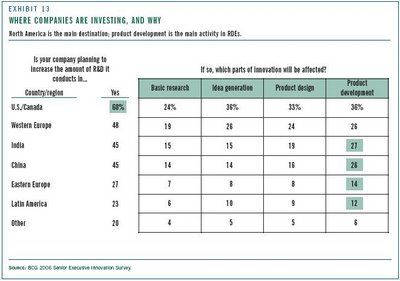
The largest target market for increased R&D spending remains the USA. And Western Europe still comes in second, albeit barely. India and China are rapidly becoming more important. About 45% of respondents said their company planned to increase R&D spending in China; and the same number planned to increase R&D spending in India. This is up from 2005, when only one-third of companies were planning to increase their R&D investments in 'rapidly developing economies.'
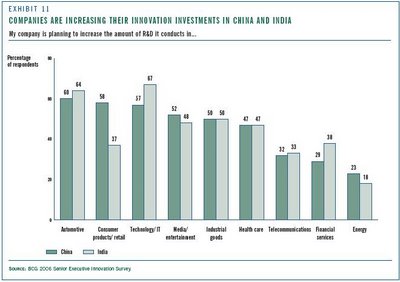
China draws increased R&D investments from significantly more consumer product/retail companies than India does. However in every other industry in the survey more or the same number of companies planned to increase their Indian R&D spending (see graph below). This comes as something as a surprise since it suggests stronger R&D growth for India than China. It is important to remember, though that China receives more foreign R&D investments in absolute terms - both FDI dollars and number of labs - and remains the most attractive location for future investments. (See UNCTAD's World Investment Report 2005 ch. 3-4.)
According to BCG's survey, cost – 34% of respondents – and localization (access to local markets) – 32% of respondents – are the main drivers for these investments. Access to R&D talent was mentioned by 21% of respondents.
The Economist Intelligence Unit (EIU) found similar drivers in their 2004 study but weighted them differently: Competition for talent, new technologies and easier market access have accelerated the process of R&D globalisation, with countries such as India and China hosting significant volumes of R&D activity for multinationals. Cost is a driver of globalisation too, but its significance can be overplayed as far as R&D goes. ... Speed of development is a more important benefit of the global research economy.
BCG also investigated the type of R&D being conducted in India and China. For anyone who's been watching the R&D space in Bangalore, Beijing and Shanghai it should come as no surprise that most of the investments are D rather than R. The main activity in India and China is product development, followed by product design. However, 15% of respondents said that their increased R&D spending would affect basic research and idea generation.
 Conclusions
BCG encourages readers to reconsider the strategies in rapidly developing economies (RDEs), especially in terms of utilizing local talent to conduct more basic research and idea generation in these locations. This is somewhat at odds with the laments of companies that do engage in very high-end research: Development talent is plentiful, but research talent is very hard to find in most industries.
A note on the survey sample: Of the 1'070 respondents to the survey 450 were employed in the US, 71 in India, and 15 in China. The bulk of the rest were from Western economies. I wonder whether this skewed some of the comparative figures on India and China...
Over the past year and a half, BCG has published various surveys, reports and “opportunities for action” on research and development in India, China and other rapidly emerging economies. The most interesting data are in the Innovation Survey 2006.
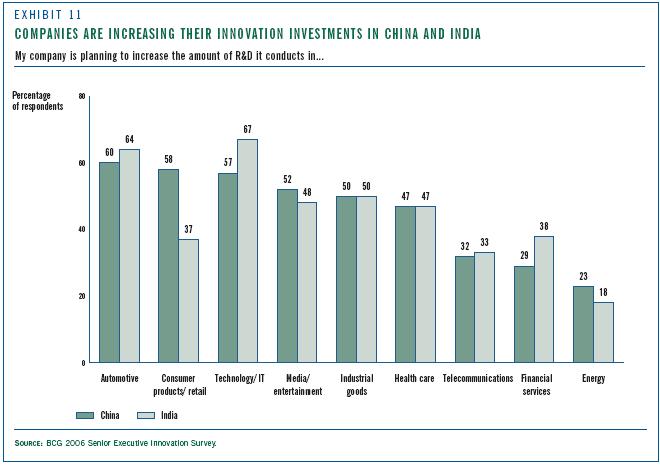
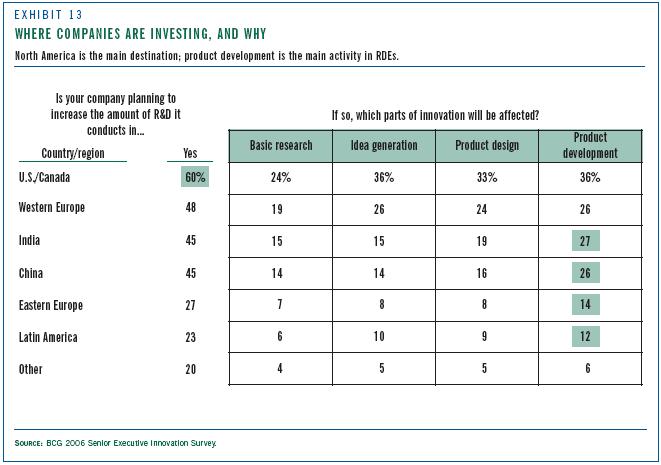
The largest target market for increased R&D spending remains the USA. And Western Europe still comes in second, albeit barely. India and China are rapidly becoming more important. About 45% of respondents said their company planned to increase R&D spending in China; and the same number planned to increase R&D spending in India. This is up from 2005, when only one-third of companies were planning to increase their R&D investments in 'rapidly developing economies.'
China draws increased R&D investments from significantly more consumer product/retail companies than India does. However in every other industry in the survey more or the same number of companies planned to increase their Indian R&D spending (see graph below). This comes as something as a surprise since it suggests stronger R&D growth for India than China. It is important to remember, though that China receives more foreign R&D investments in absolute terms - both FDI dollars and number of labs - and remains the most attractive location for future investments. (See UNCTAD's World Investment Report 2005 ch. 3-4.)
According to BCG's survey, cost – 34% of respondents – and localization (access to local markets) – 32% of respondents – are the main drivers for these investments. Access to R&D talent was mentioned by 21% of respondents.
The Economist Intelligence Unit (EIU) found similar drivers in their 2004 study but weighted them differently: Competition for talent, new technologies and easier market access have accelerated the process of R&D globalisation, with countries such as India and China hosting significant volumes of R&D activity for multinationals. Cost is a driver of globalisation too, but its significance can be overplayed as far as R&D goes. ... Speed of development is a more important benefit of the global research economy.
BCG also investigated the type of R&D being conducted in India and China. For anyone who's been watching the R&D space in Bangalore, Beijing and Shanghai it should come as no surprise that most of the investments are D rather than R. The main activity in India and China is product development, followed by product design. However, 15% of respondents said that their increased R&D spending would affect basic research and idea generation.
 Conclusions
BCG encourages readers to reconsider the strategies in rapidly developing economies (RDEs), especially in terms of utilizing local talent to conduct more basic research and idea generation in these locations. This is somewhat at odds with the laments of companies that do engage in very high-end research: Development talent is plentiful, but research talent is very hard to find in most industries.
A note on the survey sample: Of the 1'070 respondents to the survey 450 were employed in the US, 71 in India, and 15 in China. The bulk of the rest were from Western economies. I wonder whether this skewed some of the comparative figures on India and China...
Sunday
Great new resource
Wednesday
China breaks into top 10 patent filers
One of the few areas where developing countries do tend to have reliable R&D statistics is patent numbers. And these have made news recently. Here's SciDev.Net's report:
China is, for the first time, among the top ten countries filing international patents with the World Intellectual Property Organization (WIPO).
WIPO announced on 3 February that China last year filed 2,452 patents with its Patent Cooperation Treaty, which allows inventors to use a single registration to seek patents in many countries simultaneously.
This is a 44 per cent increase on 2004, and means China has overtaken Australia, Canada and Italy to become the tenth biggest user of the treaty, adopted in 2000.
Since joining the World Trade Organisation (WTO) in December 2001, there has been mounting pressure on Chinese companies to file international patents, says Sun Guorui, a professor of intellectual property at Beihang University in Beijing.
He says that this, together with China's rapid growth in research and development, could explain the increase in international patents reported by WIPO.
China is the world's largest producer of DVD players, and under WTO rules has agreed to pay royalties worth 23 billion yuan (US$2.9 billion) to the holders of relevant international patents — such as Dutch multinational Philips Electronics and Japan's Sony.
"These fees for DVDs and other products have forced Chinese businesses to be more conscious of the importance of international patent filing," says Sun.
In 2005, the total number of patents filed with WIPO's Patent Cooperation Treaty exceeded 134,000, representing a 9.4 per cent increase over 2004.
The number of patents filed by developing countries grew by 20 per cent between 2004 and 2005, and now represent 6.7 per cent of the total.
Leading this growth are China (with 2,452 patents in 2005), India (648), South Africa (336), Brazil (283) and Mexico (136).
China's State Intellectual Property Office says it received more than 476,000 patent applications in 2005, an increase of nearly 35 per cent over 2004.
Resources on India's patents are:
- The website of the patent office
- Patent search
- Patent facilitating centre
- Summary of TRIPS-related changes with sources
More generally: The OECD's patents page with useful links.
China is, for the first time, among the top ten countries filing international patents with the World Intellectual Property Organization (WIPO).
WIPO announced on 3 February that China last year filed 2,452 patents with its Patent Cooperation Treaty, which allows inventors to use a single registration to seek patents in many countries simultaneously.
This is a 44 per cent increase on 2004, and means China has overtaken Australia, Canada and Italy to become the tenth biggest user of the treaty, adopted in 2000.
Since joining the World Trade Organisation (WTO) in December 2001, there has been mounting pressure on Chinese companies to file international patents, says Sun Guorui, a professor of intellectual property at Beihang University in Beijing.
He says that this, together with China's rapid growth in research and development, could explain the increase in international patents reported by WIPO.
China is the world's largest producer of DVD players, and under WTO rules has agreed to pay royalties worth 23 billion yuan (US$2.9 billion) to the holders of relevant international patents — such as Dutch multinational Philips Electronics and Japan's Sony.
"These fees for DVDs and other products have forced Chinese businesses to be more conscious of the importance of international patent filing," says Sun.
In 2005, the total number of patents filed with WIPO's Patent Cooperation Treaty exceeded 134,000, representing a 9.4 per cent increase over 2004.
The number of patents filed by developing countries grew by 20 per cent between 2004 and 2005, and now represent 6.7 per cent of the total.
Leading this growth are China (with 2,452 patents in 2005), India (648), South Africa (336), Brazil (283) and Mexico (136).
China's State Intellectual Property Office says it received more than 476,000 patent applications in 2005, an increase of nearly 35 per cent over 2004.
Resources on India's patents are:
- The website of the patent office
- Patent search
- Patent facilitating centre
- Summary of TRIPS-related changes with sources
More generally: The OECD's patents page with useful links.
Tuesday
R&D in China and India: Great image, few reliable numbers
I’ve been working on a round-up of Indian and Chinese R&D statistics. The first thing that caught my attention was that (foreign) R&D in China seemed to be getting much more scholarly attention than Indian R&D.
A quick Google search provides some backup for this hunch. Searching Google Scholar for <India “R&D”> returns 21’600 hits. A search for <China “R&D”> returns 32’200 hits. Of course, there may be all kinds of junk in those hits, but a factor of 1.5 does show some difference. Another back of the envelope technique I used was to search for India and China in the journal “R&D management.” Searching for India returned 30 citations; searching for China returned 44. (Again, this needs to be taken cautiously since most of the differential is due to a special issue on R&D management in China).
On the other hand, in regular (business) news, the two countries are about even. The same Google searches as above in Google News returned 1’130 hits for India and 1’110 for China today.
Further searching showed that it’s quite difficult to put together a rough and ready overview of R&D statistics for India from the comfort of your desk. Few numbers are available online, and various databases contradict each other. (For example, the reported number of engineering and technology doctorates awarded in 1989 varies from 238 to 586, depending on the source.) The most useful numbers (for an outside investor) are provided by the software industry association, NASSCOM – and even these are meager and purely industry focused.
China, on the other hand, publishes a handy bunch of figures on the website of the Ministry of Science and Technology. Of course, Chinese government statistics are notoriously unreliable; but at least they appear to publish a uniform set of numbers and provide easy access to them.
The point here is less one of scholarly research than of marketing. India and China are competing for foreign R&D dollars (and spillovers). To do this, they need to demonstrate the availability of research talent. Conversations I have had, suggest that neither country is building its R&D strength on available resources. In both countries (though more so in China), proximity to a huge customer base is an important reason for firms to conduct R&D there. Lower costs also help. Both benefit from the West’s realization that India and China have very large college-educated populations.
However, “college-educated” does not equal “research-trained.” Several MNC labs have found that only a handful of elite schools provide the same kind of research training as they expect from researchers elsewhere in the world. As I heard time and again, development talent is plentiful; the research talent pool is very small.
Given a less than ideal labor pool, how do Bangalore and Beijing achieve their status of Asia’s R&D hubs? How can they expect to outperform Japan in terms of research?
China’s strategy has apparently been to muscle its way into the field by requiring foreign firms to set up labs if they wish to get permits for their low-cost factories – and by investing heavily in state-of-the-art infrastructure.
Bangalore seems to be benefiting from a halo effect: As the go-to spot for software development it becomes a natural location for IT research as well. In both countries, the case has also been made that returnees play a crucial role. As more interesting jobs open up (e.g. team leader in an R&D lab), more highly qualified emigrants find it worth their while to return home. Of course, more opportunities and market demand will eventually also have an effect on research training – whether in universities or in industry.
In the end, excellence in a field may translate into R&D prowess. And an image as an R&D hub may help sustain the current boom long enough for an adequate talent pool to develop. Until we have reliable numbers, though, nobody will be able to tell for sure.
A quick Google search provides some backup for this hunch. Searching Google Scholar for <India “R&D”> returns 21’600 hits. A search for <China “R&D”> returns 32’200 hits. Of course, there may be all kinds of junk in those hits, but a factor of 1.5 does show some difference. Another back of the envelope technique I used was to search for India and China in the journal “R&D management.” Searching for India returned 30 citations; searching for China returned 44. (Again, this needs to be taken cautiously since most of the differential is due to a special issue on R&D management in China).
On the other hand, in regular (business) news, the two countries are about even. The same Google searches as above in Google News returned 1’130 hits for India and 1’110 for China today.
Further searching showed that it’s quite difficult to put together a rough and ready overview of R&D statistics for India from the comfort of your desk. Few numbers are available online, and various databases contradict each other. (For example, the reported number of engineering and technology doctorates awarded in 1989 varies from 238 to 586, depending on the source.) The most useful numbers (for an outside investor) are provided by the software industry association, NASSCOM – and even these are meager and purely industry focused.
China, on the other hand, publishes a handy bunch of figures on the website of the Ministry of Science and Technology. Of course, Chinese government statistics are notoriously unreliable; but at least they appear to publish a uniform set of numbers and provide easy access to them.
The point here is less one of scholarly research than of marketing. India and China are competing for foreign R&D dollars (and spillovers). To do this, they need to demonstrate the availability of research talent. Conversations I have had, suggest that neither country is building its R&D strength on available resources. In both countries (though more so in China), proximity to a huge customer base is an important reason for firms to conduct R&D there. Lower costs also help. Both benefit from the West’s realization that India and China have very large college-educated populations.
However, “college-educated” does not equal “research-trained.” Several MNC labs have found that only a handful of elite schools provide the same kind of research training as they expect from researchers elsewhere in the world. As I heard time and again, development talent is plentiful; the research talent pool is very small.
Given a less than ideal labor pool, how do Bangalore and Beijing achieve their status of Asia’s R&D hubs? How can they expect to outperform Japan in terms of research?
China’s strategy has apparently been to muscle its way into the field by requiring foreign firms to set up labs if they wish to get permits for their low-cost factories – and by investing heavily in state-of-the-art infrastructure.
Bangalore seems to be benefiting from a halo effect: As the go-to spot for software development it becomes a natural location for IT research as well. In both countries, the case has also been made that returnees play a crucial role. As more interesting jobs open up (e.g. team leader in an R&D lab), more highly qualified emigrants find it worth their while to return home. Of course, more opportunities and market demand will eventually also have an effect on research training – whether in universities or in industry.
In the end, excellence in a field may translate into R&D prowess. And an image as an R&D hub may help sustain the current boom long enough for an adequate talent pool to develop. Until we have reliable numbers, though, nobody will be able to tell for sure.
Sunday
Foreign direct investment in R&D
Foreign direct investment in industrial research in the pharmaceutical and electronics industries - results from a survey of multinational firms, Walter Kuemmerle, Research Policy 28, 1999.
One way of investigating the globalization of R&D is to analyze streams of foreign direct investment (FDI). Where and why firms do invest in R&D abroad? Kuemmerle's 1999 paper in Research Policy addresses these questions.
Chronology
Kuemmerle researched 32 multinational companies (MNCs) from the United States, Japan, Germany, France, and the Netherlands. In 1965, these firms carried out 6.2% of their R&D abroad (as measured by employment numbers). In 1995, the corresponding figure was 25.8%, a huge increase.
U.S. firms led this wave of international expansion, investing first in Europe, then Japan, and later other countries around the world. Typically, they had set up multiple research centers within the U.S. before expanding abroad.
European firms followed with investments in other European countries, then in the U.S., and finally in Japan. At the time the study was conducted, they had few R&D activities in other parts of the world.
Japanese firms were the last firms studied to extend their R&D activities abroad. Unlike the others, they tended to invest in multiple locations simultaneously.
However, since this paper doesn't include Swedish or Swiss firms, and only 1 Dutch firm, the chronology may be somewhat skewed. Firms from small European countries often set up R&D activities abroad out of necessity, long before their counterparts from larger companies considered a similar move.
Type of R&D conducted abroad
Firms locate their R&D abroad for two reasons:
1. to exploit competitive advantages in new markets (type 1),
2. to augment their competitive advantage and gain new expertise (type 2).
Kuemmerle also discovered that a firm's first R&D venture abroad was often aimed at exploiting its comparative advantage in a new country. This would often involve adapting products and processes to local market conditions. Later, the second type of expansion would occur.
Perhaps it took time for managers to trust the quality of R&D produced abroad, but also to assess the scientific strengths of the labor pool and their potential fit with the firm's overall strategy. It's a bit of a stretch, but this could be considered an example of absorptive capacity at work. Kuemmerle points out that it is easier to set up and manage type 1 facilities, and that the experience gained by establishing a type 1 site is conducive to the better establishment and management of type 2 sites, later.
At the time the study was conducted, only 5 R&D labs were recorded for India and China for all of the 32 firms. Only one very small lab was engaged in augmenting it's parent firm's competitive advantage. Although, I have yet to compile the relevant numbers, it is obvious that the situation has dramatically changed. The number of R&D labs in India and China today is staggering, and many are located so as to exploit expertise that is unavailable (or not available in large enough quantities) at a firm's other locations.
As some of these locations develop reputations as centers of excellence, firms may become willing to engage in type 2 research faster. For example, large industrial and engineering firms locate R&D labs in Bangalore to augment their software capabilities. As one VP of R&D put it, Bangalore is the place to get the best software expertise, so the lab there is expected to make up for the company's current IT disadvantage.
NB: Even in 1999, Kuemmerle noted that the importance of type 2 sites was increasing.
Modes of entry
When firms set up a new R&D lab they can choose between establishing a "green-field" site, acquiring an existing lab or engaging in a joint-venture. Joint-ventures often entail IP problems for the firm. Acquiring an existing lab is difficult because its integration into the firm's culture is tricky: Researchers are often alienated and leave, especially in well-known centres of excellence where their skills are in high demand. Kuemmerle finds that 79% of all sites in his sample were indeed green-field sites.
Locations
The U.S. is the most attractive location for FDI in R&D. It attracted 30% of all sites. In 1999, very few sites were located outside of the U.S., Europe and Japan, and these were restricted to Canada, Australia, a few Asian countries (China, India, Singapore etc.) and Chile.
The study doesn't include R&D sites of MNCs located in emerging economies. I would guess that most would locate a foreign R&D site in the U.S., but am curious to see if there's more data on this.
One way of investigating the globalization of R&D is to analyze streams of foreign direct investment (FDI). Where and why firms do invest in R&D abroad? Kuemmerle's 1999 paper in Research Policy addresses these questions.
Chronology
Kuemmerle researched 32 multinational companies (MNCs) from the United States, Japan, Germany, France, and the Netherlands. In 1965, these firms carried out 6.2% of their R&D abroad (as measured by employment numbers). In 1995, the corresponding figure was 25.8%, a huge increase.
U.S. firms led this wave of international expansion, investing first in Europe, then Japan, and later other countries around the world. Typically, they had set up multiple research centers within the U.S. before expanding abroad.
European firms followed with investments in other European countries, then in the U.S., and finally in Japan. At the time the study was conducted, they had few R&D activities in other parts of the world.
Japanese firms were the last firms studied to extend their R&D activities abroad. Unlike the others, they tended to invest in multiple locations simultaneously.
However, since this paper doesn't include Swedish or Swiss firms, and only 1 Dutch firm, the chronology may be somewhat skewed. Firms from small European countries often set up R&D activities abroad out of necessity, long before their counterparts from larger companies considered a similar move.
Type of R&D conducted abroad
Firms locate their R&D abroad for two reasons:
1. to exploit competitive advantages in new markets (type 1),
2. to augment their competitive advantage and gain new expertise (type 2).
Kuemmerle also discovered that a firm's first R&D venture abroad was often aimed at exploiting its comparative advantage in a new country. This would often involve adapting products and processes to local market conditions. Later, the second type of expansion would occur.
Perhaps it took time for managers to trust the quality of R&D produced abroad, but also to assess the scientific strengths of the labor pool and their potential fit with the firm's overall strategy. It's a bit of a stretch, but this could be considered an example of absorptive capacity at work. Kuemmerle points out that it is easier to set up and manage type 1 facilities, and that the experience gained by establishing a type 1 site is conducive to the better establishment and management of type 2 sites, later.
At the time the study was conducted, only 5 R&D labs were recorded for India and China for all of the 32 firms. Only one very small lab was engaged in augmenting it's parent firm's competitive advantage. Although, I have yet to compile the relevant numbers, it is obvious that the situation has dramatically changed. The number of R&D labs in India and China today is staggering, and many are located so as to exploit expertise that is unavailable (or not available in large enough quantities) at a firm's other locations.
As some of these locations develop reputations as centers of excellence, firms may become willing to engage in type 2 research faster. For example, large industrial and engineering firms locate R&D labs in Bangalore to augment their software capabilities. As one VP of R&D put it, Bangalore is the place to get the best software expertise, so the lab there is expected to make up for the company's current IT disadvantage.
NB: Even in 1999, Kuemmerle noted that the importance of type 2 sites was increasing.
Modes of entry
When firms set up a new R&D lab they can choose between establishing a "green-field" site, acquiring an existing lab or engaging in a joint-venture. Joint-ventures often entail IP problems for the firm. Acquiring an existing lab is difficult because its integration into the firm's culture is tricky: Researchers are often alienated and leave, especially in well-known centres of excellence where their skills are in high demand. Kuemmerle finds that 79% of all sites in his sample were indeed green-field sites.
Locations
The U.S. is the most attractive location for FDI in R&D. It attracted 30% of all sites. In 1999, very few sites were located outside of the U.S., Europe and Japan, and these were restricted to Canada, Australia, a few Asian countries (China, India, Singapore etc.) and Chile.
The study doesn't include R&D sites of MNCs located in emerging economies. I would guess that most would locate a foreign R&D site in the U.S., but am curious to see if there's more data on this.
Monday
Global R & D
Harnessing innovation: R&D in a global growth economy, Economist Intelligence Unit, 2004
The Economist Intelligence Unit has published a new white paper: Harnessing Innovation. It is based on an online survey and in-depth interviews with companies such as Agilent, IBM, AMD Siemens, BMW and Nokia.
From the results:
Market- and customer-driven innovation has moved from buzz-word to reality, although keeping customers focused on innovation projects is a significant challenge once initial enthusiasm has ebbed.
The survey clearly indicates that R&D is high up the hierarchy of corporate priorities — asked to identify their overall strategic priorities, respondents put product development third, just behind cost-cutting and strengthening customer relationships. But the emphasis rests heavily on the D(evelopment)part of the equation. Market pressures to keep up with competitors’ innovations and to satisfy more demanding customers are the two top drivers of R&D activity, according to survey respondents. In this environment, anything companies can do to reduce the odds of failure as they embark on new research projects is critical.
A more market-oriented approach to R&D is driving R&D leaders to work more closely with customers as they develop new products and services. But there are challenges in this approach. While collaboration is key for creating demand-driven innovations, survey participants also noted that maintaining customer involvement ranked as one of the leading roadblocks to successful R&D projects. This evolving innovation landscape promises a more effective R&D process, one that sharpens the decision-making process as firms choose where to allocate their R&D spend and that increases the chances of launching commercially viable new products. It may also encourage an even more pronounced division of labour in the world of research, with governments, universities and start-up companies focusing on “blue-sky” research projects and companies working on more incremental development activities.
R&D has gone global with many firms distributing their R&D centers around the world. This is driven by quality and time-to-market factors rather than just cost-cutting. In some cases research is still centralized and locations further afield focus on development and process innovation.
Competition for talent, new technologies and easier market access have accelerated the process of R&D globalisation, with countries such as India and China hosting significant volumes of R&D activity for multinationals. Cost is a driver of globalisation too, but its significance can be overplayed as far as R&D goes. Once infrastructure and coordination costs for managing distributed R&D facilities are included, the total savings are not as huge as popular headlines suggest. Speed of development is a more important benefit of the global research economy.
The survey finds organizational problems to be the single greatest challenge for R&D efforts. It is therefore especially interesting to note the different models implemented by firms that distribute R&D activities globally.
If you have research and development activities in time zones around the world,how do you coordinate that activity?
The report provides very little information on how global R&D management is implemented, although the challenges are certainly highlighted.
Although there are clear economic reasons for locating certain R&D work in lower-cost countries, relocating R&D resources solely because of labour costs is a losing proposition. “There is no such thing as low-cost intellectual property”, declares IBM’s Dr Horn. Aside from the travel, coordination and communications expense, the labour rate itself is climbing as recipient countries become more sophisticated economies. The current rule of thumb among India’s IT professionals is to expect a 15% pay rise every year. Such narrowing becomes even more pronounced once top management cost is included.
More important to the globalisation trend is the ability to innovate around the clock. But it is no small task to manage this process. According to Fred Weber, chief technology officer for AMD, a leading semiconductor manufacturer, companies must avoid the pitfalls of compartmentalisation. “Whenever possible, we try to ensure that a remote site does not build up its own little fiefdom of products that it is making. Rather we aim to develop an integrated global engineering force. So we might split projects across multiple locations.”
AMD ’s latest Opteron processor resulted from teams working simultaneously in Texas, California, Singapore and Dresden in Germany, for example. But the challenges posed by this structure can be formidable, acknowledges Mr Weber. “When you see somebody everyday and you have lunch with them, you understand them a lot better than when you talk on the phone to them once a week and see them once a year.” Cultural differences further exacerbate this lack of face-to-face contact.
The Economist Intelligence Unit has published a new white paper: Harnessing Innovation. It is based on an online survey and in-depth interviews with companies such as Agilent, IBM, AMD Siemens, BMW and Nokia.
From the results:
Market- and customer-driven innovation has moved from buzz-word to reality, although keeping customers focused on innovation projects is a significant challenge once initial enthusiasm has ebbed.
The survey clearly indicates that R&D is high up the hierarchy of corporate priorities — asked to identify their overall strategic priorities, respondents put product development third, just behind cost-cutting and strengthening customer relationships. But the emphasis rests heavily on the D(evelopment)part of the equation. Market pressures to keep up with competitors’ innovations and to satisfy more demanding customers are the two top drivers of R&D activity, according to survey respondents. In this environment, anything companies can do to reduce the odds of failure as they embark on new research projects is critical.
A more market-oriented approach to R&D is driving R&D leaders to work more closely with customers as they develop new products and services. But there are challenges in this approach. While collaboration is key for creating demand-driven innovations, survey participants also noted that maintaining customer involvement ranked as one of the leading roadblocks to successful R&D projects. This evolving innovation landscape promises a more effective R&D process, one that sharpens the decision-making process as firms choose where to allocate their R&D spend and that increases the chances of launching commercially viable new products. It may also encourage an even more pronounced division of labour in the world of research, with governments, universities and start-up companies focusing on “blue-sky” research projects and companies working on more incremental development activities.
R&D has gone global with many firms distributing their R&D centers around the world. This is driven by quality and time-to-market factors rather than just cost-cutting. In some cases research is still centralized and locations further afield focus on development and process innovation.
Competition for talent, new technologies and easier market access have accelerated the process of R&D globalisation, with countries such as India and China hosting significant volumes of R&D activity for multinationals. Cost is a driver of globalisation too, but its significance can be overplayed as far as R&D goes. Once infrastructure and coordination costs for managing distributed R&D facilities are included, the total savings are not as huge as popular headlines suggest. Speed of development is a more important benefit of the global research economy.
The survey finds organizational problems to be the single greatest challenge for R&D efforts. It is therefore especially interesting to note the different models implemented by firms that distribute R&D activities globally.
If you have research and development activities in time zones around the world,how do you coordinate that activity?
30% Research and development is coordinated on a regional basis (eg,EMEA,the Americas)
30% Research and development is managed globally,with round-the-clock teams who work consecutively on the same projects
25% Research and development is carried out separately in each country
16% Other
The report provides very little information on how global R&D management is implemented, although the challenges are certainly highlighted.
Although there are clear economic reasons for locating certain R&D work in lower-cost countries, relocating R&D resources solely because of labour costs is a losing proposition. “There is no such thing as low-cost intellectual property”, declares IBM’s Dr Horn. Aside from the travel, coordination and communications expense, the labour rate itself is climbing as recipient countries become more sophisticated economies. The current rule of thumb among India’s IT professionals is to expect a 15% pay rise every year. Such narrowing becomes even more pronounced once top management cost is included.
More important to the globalisation trend is the ability to innovate around the clock. But it is no small task to manage this process. According to Fred Weber, chief technology officer for AMD, a leading semiconductor manufacturer, companies must avoid the pitfalls of compartmentalisation. “Whenever possible, we try to ensure that a remote site does not build up its own little fiefdom of products that it is making. Rather we aim to develop an integrated global engineering force. So we might split projects across multiple locations.”
AMD ’s latest Opteron processor resulted from teams working simultaneously in Texas, California, Singapore and Dresden in Germany, for example. But the challenges posed by this structure can be formidable, acknowledges Mr Weber. “When you see somebody everyday and you have lunch with them, you understand them a lot better than when you talk on the phone to them once a week and see them once a year.” Cultural differences further exacerbate this lack of face-to-face contact.
The cost of losing R&D
The Economist carried a comparison of US and European pharmaceuticals industries (based on a Bain study) a while back. In their analysis, they debunk the idea that Europe is benefiting from a free ride. Government pricing regimes may be keeping drug prices low, leaving American patients and insurers to pick up the tab of ever more expensive drug development. However, they are losing out overall - the policy is currently incurring a net loss in Germany for one.
As Europe becomes a less attractive market and red tape further hinders innovation, R&D (and the jobs that go with it) and cutting edge health care are moving to the United States.
IN THE drug industry, they call it “Europe's free ride”. Government pricing regimes mean that prescription drugs cost far less in Europe than in America, where a growing proportion of new drugs are developed—presumably because Americans are willing to bear the lion's share of development costs. On the face of it, Europe reaps big rewards. It spends 60% per head less on drugs than America. In 1992, the gap was 30%. Had spending kept pace with America, last year alone Europe would have shelled out an extra $160 billion. The cumulative “saving” since 1992 is approaching $1 trillion—quite some free ride.
But is the saving from cheap drugs more apparent than real? And are Europe's drug firms in fact struggling to keep up with more dynamic American competitors? A new study by Bain, a consultant, argues that the existing pricing regimes are bad for everyone, including patients. “The free ride is not free,” argues Paul Rosenburg, a co-author. “If governments and drug companies begin to accept this, then future policy on health-care innovation and spending can be far more rational.”
On the other hand, America gains from its growing dominance of drug research and development (R&D). A decade ago, Europe and America each spent roughly $10 billion a year on drug R&D. Now, America spends almost $30 billion annually, and Europe a little more than $20 billion. A growing number of firms now base their R&D efforts in America. Drugs R&D in Germany fell by 3% in 1992-2002.
One result is a striking decline in European drug innovation. Bain examined how many so-called new molecular entities (NMEs) have been produced in recent years. In 1993-97, Europe launched 81 NMEs and America 48. But in 1998-2002, the respective figures were 44 and 85, almost an exact reversal.
Exactly how drug-pricing regimes influence innovation is complex—and much debated. According to Bain, research shows that the main economic factor driving where firms locate their R&D is how big, and quick, are the potential profits. That gives America an advantage over Europe, where price controls slow down profit-taking. True, early-stage research can take place anywhere in the world—and big drug firms are increasingly looking to shift this to lower-cost places. (GSK recently linked up to do research with Ranbaxy, a leading Indian drug firm.) But the bulk of costs are incurred in the development phase between early-stage and market. And the process of drug approval remains very much a national, as opposed to global, activity. So it makes sense for firms to put promising drugs on trial in the market where there is most to gain—namely, for now, America.
According to Bain, a proper accounting for Germany's spending on drugs produces an alarming result. In 2002, Germany saved $19 billion because it spent much less per head than America on drugs. On the other hand, says Bain, in the same year, Germany lost out on $4 billion from R&D, patents and related benefits that went elsewhere. It lost $8 billion because high-value jobs went somewhere else—plus the benefits of those jobs from the “multiplier effect”. German drug firms would have made $3 billion more profit if they had kept pace with rivals elsewhere. A further $2 billion was lost as the country shed corporate headquarters and the benefits they bring. The cost of poorer-than-necessary health was $5 billion.
Of course, these calculations rely on some rough and ready assumptions. Even so, Bain arguably errs on the side of caution. It plays down, rather than up, the multiplier benefits of jobs in the drug industry, for instance. In sum, it reckons that Germany's $19 billion saving is in fact a $3 billion net loss. “When you add up all of the costs, the free rider model is actually quite expensive,” argues Mr Rosenburg.
As Europe becomes a less attractive market and red tape further hinders innovation, R&D (and the jobs that go with it) and cutting edge health care are moving to the United States.
IN THE drug industry, they call it “Europe's free ride”. Government pricing regimes mean that prescription drugs cost far less in Europe than in America, where a growing proportion of new drugs are developed—presumably because Americans are willing to bear the lion's share of development costs. On the face of it, Europe reaps big rewards. It spends 60% per head less on drugs than America. In 1992, the gap was 30%. Had spending kept pace with America, last year alone Europe would have shelled out an extra $160 billion. The cumulative “saving” since 1992 is approaching $1 trillion—quite some free ride.
But is the saving from cheap drugs more apparent than real? And are Europe's drug firms in fact struggling to keep up with more dynamic American competitors? A new study by Bain, a consultant, argues that the existing pricing regimes are bad for everyone, including patients. “The free ride is not free,” argues Paul Rosenburg, a co-author. “If governments and drug companies begin to accept this, then future policy on health-care innovation and spending can be far more rational.”
On the other hand, America gains from its growing dominance of drug research and development (R&D). A decade ago, Europe and America each spent roughly $10 billion a year on drug R&D. Now, America spends almost $30 billion annually, and Europe a little more than $20 billion. A growing number of firms now base their R&D efforts in America. Drugs R&D in Germany fell by 3% in 1992-2002.
One result is a striking decline in European drug innovation. Bain examined how many so-called new molecular entities (NMEs) have been produced in recent years. In 1993-97, Europe launched 81 NMEs and America 48. But in 1998-2002, the respective figures were 44 and 85, almost an exact reversal.
Exactly how drug-pricing regimes influence innovation is complex—and much debated. According to Bain, research shows that the main economic factor driving where firms locate their R&D is how big, and quick, are the potential profits. That gives America an advantage over Europe, where price controls slow down profit-taking. True, early-stage research can take place anywhere in the world—and big drug firms are increasingly looking to shift this to lower-cost places. (GSK recently linked up to do research with Ranbaxy, a leading Indian drug firm.) But the bulk of costs are incurred in the development phase between early-stage and market. And the process of drug approval remains very much a national, as opposed to global, activity. So it makes sense for firms to put promising drugs on trial in the market where there is most to gain—namely, for now, America.
According to Bain, a proper accounting for Germany's spending on drugs produces an alarming result. In 2002, Germany saved $19 billion because it spent much less per head than America on drugs. On the other hand, says Bain, in the same year, Germany lost out on $4 billion from R&D, patents and related benefits that went elsewhere. It lost $8 billion because high-value jobs went somewhere else—plus the benefits of those jobs from the “multiplier effect”. German drug firms would have made $3 billion more profit if they had kept pace with rivals elsewhere. A further $2 billion was lost as the country shed corporate headquarters and the benefits they bring. The cost of poorer-than-necessary health was $5 billion.
Of course, these calculations rely on some rough and ready assumptions. Even so, Bain arguably errs on the side of caution. It plays down, rather than up, the multiplier benefits of jobs in the drug industry, for instance. In sum, it reckons that Germany's $19 billion saving is in fact a $3 billion net loss. “When you add up all of the costs, the free rider model is actually quite expensive,” argues Mr Rosenburg.
Friday
Knowledge seekers
Knowledge Seeking and Location Choice of Foreign Direct Investment in the United States, Wilbur Chung and Juan Alcacer, 2002
In the latest Knowledge@Wharton newsletter, Wilbur Chung and Juan Alcacer present the hypothesis that foreign direct investment (FDI) is not purely cost or market driven. Companies acquire firms, engage in joint-ventures and set up green fields ventures for access to unique knowledge - not just to cut cost or gain access to markets.
(The academic paper can be found here.)
While such seekers have historically been characterized as technology laggards trying to catch up with market movers, more recently scholars have embraced the idea that leaders, too, invest abroad as they seek to broaden or deepen their knowledge.
The study covers FDI in the United States (by state and by economic region).
Not surprisingly, they found that knowledge seeking is most prevalent among foreign companies in R&D-heavy industries such as pharmaceuticals, semiconductors and electronics. In fact, they found that drug makers are twice as likely to seek knowledge abroad as companies in any other industry.
Where were knowledge seekers most likely to invest? R&D-intensive areas. 'Many investments, 32% of the sample, fall into four major metropolitan areas: New York City, San Francisco, Los Angeles and Chicago,' the researchers write. In contrast, a region of the United States known mostly for agriculture - the Dakotas and Idaho - had no investments during our investigation period.'
It seems obvious that a European biotech company would conduct R&D in the US, that a knowledge seeker in pharmaceuticals would set up shop near Boston, or that a company seeking state-of-the-art IT knowledge might invest in operations in Silicon Valley. But what about the opposite direction? The column mentions GE's new research and development lab for medical systems in China. The lab focuses on product development tailored to emerging economies. Is this a unique example? (GE does seem to be a pioneer as far as spreading R&D globally goes...)
K@W concludes that leading regions in the knowledge industry should be wary about inviting foreign firms and giving them tax-breaks or other incentives.
Traditionally, investments from foreign firms have been celebrated by holding press conferences and ribbon-cutting ceremonies, as South Carolina and Alabama did when they landed BMW and Mercedes. But if Chung is right, these investments may not always be unalloyed victories. 'If many foreign firms enter seeking new knowledge, [productivity] gains may not accrue, and a nation's technological uniqueness might be more quickly replicated,' he and Alcacer point out in their paper. Of course investments from foreign firms may still bring benefits such as more jobs and spin-off economic activity as, for example, suppliers spring up near the foreign firm's new plant.
This sounds much like an absurd reversal of the current outsourcing debate - we don't want our firms to invest abroad because that means we'll lose our jobs (even though our firms will be more competitive), but we don't want foreign firms to invest here because that means we'll lose our competitive knowledge edge (even though we'll get more jobs).
Besides, the argument doesn't hold. Knowledge doesn't diminish by being shared - and if foreign firms invest in US high-tech clusters, this strengthens the competitive advantage of those clusters by increasing their innovative churn. Many of a cluster's advantages (labour pool, social networks, proximity to leading research labs/universities etc.) don't travel well.
To be fair, Chung and Alcacer acknowledge the importance of place in other parts of the discussion, and the 'threat' to American competitiveness is only vaguely alluded to in a generalized statement in their academic paper.
An objection to Chung and Alcacer's research - and to the notion of knowledge seeking via foreign expansion, in general - might be that investing abroad is a costly way to learn. After all, patents and technical manuals are widely published, and newly graduated scientists and engineers are eager for jobs.
But Chung argues that this objection misconstrues the nature of knowledge. 'Knowledge can be broken into a codifiable piece - the stuff you can write down - and a tacit piece,' he explains. ... Consider eating at a restaurant, he says. 'You don't really experience it unless you go there yourself. You can have someone tell you about it. You can order takeout from the restaurant. You can buy the cookbook. But to get the full benefit of the experience, you have to go there.'
Think about it: Which advantage is eroded more easily - an emerging economy's lower labor cost, or the United States' R&D and innovation prowess? (Doubters may want to read Thomas Friedman's recent op-ed.)
By all means, negotiate IPR protections when entering alliances and joint-ventures, but don't get paranoid about foreigners transferring their money and their researchers here.
In the latest Knowledge@Wharton newsletter, Wilbur Chung and Juan Alcacer present the hypothesis that foreign direct investment (FDI) is not purely cost or market driven. Companies acquire firms, engage in joint-ventures and set up green fields ventures for access to unique knowledge - not just to cut cost or gain access to markets.
(The academic paper can be found here.)
While such seekers have historically been characterized as technology laggards trying to catch up with market movers, more recently scholars have embraced the idea that leaders, too, invest abroad as they seek to broaden or deepen their knowledge.
The study covers FDI in the United States (by state and by economic region).
Not surprisingly, they found that knowledge seeking is most prevalent among foreign companies in R&D-heavy industries such as pharmaceuticals, semiconductors and electronics. In fact, they found that drug makers are twice as likely to seek knowledge abroad as companies in any other industry.
Where were knowledge seekers most likely to invest? R&D-intensive areas. 'Many investments, 32% of the sample, fall into four major metropolitan areas: New York City, San Francisco, Los Angeles and Chicago,' the researchers write. In contrast, a region of the United States known mostly for agriculture - the Dakotas and Idaho - had no investments during our investigation period.'
It seems obvious that a European biotech company would conduct R&D in the US, that a knowledge seeker in pharmaceuticals would set up shop near Boston, or that a company seeking state-of-the-art IT knowledge might invest in operations in Silicon Valley. But what about the opposite direction? The column mentions GE's new research and development lab for medical systems in China. The lab focuses on product development tailored to emerging economies. Is this a unique example? (GE does seem to be a pioneer as far as spreading R&D globally goes...)
K@W concludes that leading regions in the knowledge industry should be wary about inviting foreign firms and giving them tax-breaks or other incentives.
Traditionally, investments from foreign firms have been celebrated by holding press conferences and ribbon-cutting ceremonies, as South Carolina and Alabama did when they landed BMW and Mercedes. But if Chung is right, these investments may not always be unalloyed victories. 'If many foreign firms enter seeking new knowledge, [productivity] gains may not accrue, and a nation's technological uniqueness might be more quickly replicated,' he and Alcacer point out in their paper. Of course investments from foreign firms may still bring benefits such as more jobs and spin-off economic activity as, for example, suppliers spring up near the foreign firm's new plant.
This sounds much like an absurd reversal of the current outsourcing debate - we don't want our firms to invest abroad because that means we'll lose our jobs (even though our firms will be more competitive), but we don't want foreign firms to invest here because that means we'll lose our competitive knowledge edge (even though we'll get more jobs).
Besides, the argument doesn't hold. Knowledge doesn't diminish by being shared - and if foreign firms invest in US high-tech clusters, this strengthens the competitive advantage of those clusters by increasing their innovative churn. Many of a cluster's advantages (labour pool, social networks, proximity to leading research labs/universities etc.) don't travel well.
To be fair, Chung and Alcacer acknowledge the importance of place in other parts of the discussion, and the 'threat' to American competitiveness is only vaguely alluded to in a generalized statement in their academic paper.
An objection to Chung and Alcacer's research - and to the notion of knowledge seeking via foreign expansion, in general - might be that investing abroad is a costly way to learn. After all, patents and technical manuals are widely published, and newly graduated scientists and engineers are eager for jobs.
But Chung argues that this objection misconstrues the nature of knowledge. 'Knowledge can be broken into a codifiable piece - the stuff you can write down - and a tacit piece,' he explains. ... Consider eating at a restaurant, he says. 'You don't really experience it unless you go there yourself. You can have someone tell you about it. You can order takeout from the restaurant. You can buy the cookbook. But to get the full benefit of the experience, you have to go there.'
Think about it: Which advantage is eroded more easily - an emerging economy's lower labor cost, or the United States' R&D and innovation prowess? (Doubters may want to read Thomas Friedman's recent op-ed.)
By all means, negotiate IPR protections when entering alliances and joint-ventures, but don't get paranoid about foreigners transferring their money and their researchers here.
Tuesday
R&D in Brazil
This week, the Knowledge Economy team of the Development Gateway is focusing on Brazil as a potential tech and innovation powerhouse.
Brazil has over the past years been receiving increasing public and private investments aimed at boosting and expanding innovative activities in the country.
Brazil is the largest recipient of foreign direct investment (FDI) in Latin America, and Brazilian entrepreneurs point to FDI as a major source of new technology transfer and to the licensing of foreign technology as a major form of acquiring new technology.
When it comes to the internal capacity to absorb and create new technologies, -while Brazil has been broadening access to education at all levels-, the Brazil Competitiveness meeting hosted by the World Economic Forum in June this year pointed out that only a relatively small number of high-tech professionals are graduating. The Forum recommended that Brazil increase the number of graduating professionals and improve education, primarily by increasing specialization in fields related to the more competitive industries of the country. The Forum also pointed out other weaknesses of Brazil's innovation system, among them insufficient linkages between universities and other actors.
This again points to the importance of building local absorptive capacity rather than relying too heavily on foreign direct investment. (See also a Foreign Policy article, which Reuben pointed out.)
I recently read an article describing the Xylella fastidiosa Genome Project. The Brazilian scientists in the project made use of Europe's distributed team organization for sequencing the genome and adapted it to their own conditions - thereby greatly improving on the European model in the author's opinion. Spreading the research across numerous labs (34 sequencing labs, 1 bioinformatics lab and collaboration with 2 European labs) also helped to train more scientist in biotechnology, and to create a better base/more absorptive capacity for future research projects and the biotech industry. The choice of the organism to sequence was also significant - a citrus pathogen, which is of great interest to academics and agribusiness.
At the time, the project created quite a stir: Brazil was the first developing country to join genome sequencing as a serious player; theirs was the first plant genome to be sequenced. From EMBnet news (April 2000):
In two years, Brazil (or at least São Paulo state) has gone from essentially nothing to being one of the larger producers of sequence data in the world. It has done so not by investing massively in a large sequencing facility, but by bringing together a large number of individual labs, many of which are already using these new data and know-how in their own research. In this way, the genome projects have already had a major impact on Brazilian science.
The world has not really taken notice yet, but I would bet that within another year or two ONSA and the HCGP will have achieved the same recognition as TIGR and CGAP. Bioinformaticians and genome scientists take note!
Brazil has over the past years been receiving increasing public and private investments aimed at boosting and expanding innovative activities in the country.
Brazil is the largest recipient of foreign direct investment (FDI) in Latin America, and Brazilian entrepreneurs point to FDI as a major source of new technology transfer and to the licensing of foreign technology as a major form of acquiring new technology.
When it comes to the internal capacity to absorb and create new technologies, -while Brazil has been broadening access to education at all levels-, the Brazil Competitiveness meeting hosted by the World Economic Forum in June this year pointed out that only a relatively small number of high-tech professionals are graduating. The Forum recommended that Brazil increase the number of graduating professionals and improve education, primarily by increasing specialization in fields related to the more competitive industries of the country. The Forum also pointed out other weaknesses of Brazil's innovation system, among them insufficient linkages between universities and other actors.
This again points to the importance of building local absorptive capacity rather than relying too heavily on foreign direct investment. (See also a Foreign Policy article, which Reuben pointed out.)
I recently read an article describing the Xylella fastidiosa Genome Project. The Brazilian scientists in the project made use of Europe's distributed team organization for sequencing the genome and adapted it to their own conditions - thereby greatly improving on the European model in the author's opinion. Spreading the research across numerous labs (34 sequencing labs, 1 bioinformatics lab and collaboration with 2 European labs) also helped to train more scientist in biotechnology, and to create a better base/more absorptive capacity for future research projects and the biotech industry. The choice of the organism to sequence was also significant - a citrus pathogen, which is of great interest to academics and agribusiness.
At the time, the project created quite a stir: Brazil was the first developing country to join genome sequencing as a serious player; theirs was the first plant genome to be sequenced. From EMBnet news (April 2000):
In two years, Brazil (or at least São Paulo state) has gone from essentially nothing to being one of the larger producers of sequence data in the world. It has done so not by investing massively in a large sequencing facility, but by bringing together a large number of individual labs, many of which are already using these new data and know-how in their own research. In this way, the genome projects have already had a major impact on Brazilian science.
The world has not really taken notice yet, but I would bet that within another year or two ONSA and the HCGP will have achieved the same recognition as TIGR and CGAP. Bioinformaticians and genome scientists take note!
Subscribe to:
Posts (Atom)
